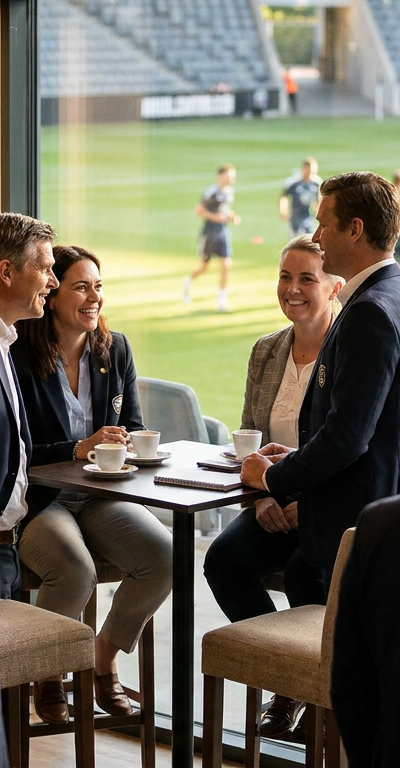
Strategy for commercial activation of sponsor networks and events

Many sports clubs experience their business networks stagnating because activities lack a clear strategy for commercial activation. When networking meetings are reduced to informal small talk without structure, the measurable value for sponsors drops, which directly affects the retention rate at the next contract renewal.
A professional approach requires club management to view the network as a business platform where success is measured by more than just attendance. It is about facilitating concrete B2B transactions and documenting the value created in the hours sponsors dedicate to the club.
Budgeting and financial framework for networking events
To ensure healthy finances in networking activities, each event must have a set budget that reflects the sponsor's investment. A misprioritization of resources can quickly erode the commercial profit from sponsorship agreements.
Below is an example of budget management for two different event types in a football club (high volume) and a handball club (high intensity/density) respectively:
| Parameter | Football Club (Business Lunch) | Handball Club (VIP Matchday) |
|---|---|---|
| Number of participants | 80-100 people | 40-50 people |
| Price per cover (Food/Drinks) | 185 DKK excl. VAT | 325 DKK excl. VAT |
| Venue rental/Setup | 2,500 DKK | 1,000 DKK (Own venue) |
| External speaker | 5,000 DKK | 0 DKK (Coach briefing) |
| Total estimated cost | 26,000 DKK | 17,250 DKK |
| Break-even (Sponsor contribution per unit) | 260 DKK per participant | 345 DKK per participant |
It is crucial that these costs are included in the "Cost of Sales" (COS) of the sold sponsorship packages, so the club does not end up giving away network value for free at the expense of sporting operations.
Structuring CRM: What should be logged after a networking meeting?
Data is the foundation for proving the network's value to a sponsor. It is not enough to know that "Company X was present." To drive a serious strategy for commercial activation of sponsor networks, the administration must systematically log interactions in the club's CRM system.
Specific parameters for logging
After each event, the network manager or a dedicated administrative employee should update the following for each participating company:
- Decision-maker level: Was it the CEO or a marketing assistant? This affects the strategic weight of the network.
- Introductions (Matchmaking): Which 2-3 companies was the sponsor introduced to?
- Fields of interest: Did the sponsor express interest in specific upcoming events or other sponsors' services?
- Lead indicators: Were follow-up meetings agreed upon between two sponsors within the club's framework?
By logging this data, the club can present a report at the annual status meeting showing: "This year, we introduced you to 12 relevant companies, including 4 potential partners within your industry."
Tracking B2B sales without being invasive
The most difficult point in the network strategy is measuring the actual sales that occur between sponsors. The club needs these figures to document ROI, but sponsors rarely want to share their exact revenue figures.
The solution is a "Value Declaration" rather than a "Revenue Declaration." Once a year, the club can send out an anonymized questionnaire to the network with categorized intervals:
| Question | Answer options (Examples) |
|---|---|
| Has the network led to new customers? | Yes / No / In progress |
| Estimated value of new orders | 0-50k / 50k-250k / 250k-500k / +500k DKK |
| How many external meetings have been booked? | Number (1-2, 3-5, 5+) |
By using intervals, the resistance to sharing data is reduced, while the club still achieves a solid statistical basis for saying: "Last season, our network generated B2B trade for over 2.5 million DKK."
Operational execution: From passive listening to active matchmaking
A strategy for commercial activation of sponsor networks often fails in the execution phase if the format is too rigid. Many clubs make the mistake of letting a speaker talk for 45 minutes, followed by 15 minutes of free time. This does not promote networking for less extroverted sponsors.
Concrete tools for matchmaking during the event:
1. Seating planning with an algorithm: Never place sponsors with their competitors unless it is a specific industry event. Make sure to seat an "experienced" networker with a new sponsor to help integration.
2. Elevator pitches in small groups: Instead of plenary presentations, divide sponsors into groups of 4, where they have exactly 2 minutes each to explain: "Who is my ideal customer, and how can the network help me right now?"
3. The host role: Club employees (sponsorship managers, directors, administrative leaders) should not stand in a group talking to each other. They should act as "stewards" who physically bring two people together and start the conversation: "Henrik, have you met Søren? Søren is looking for a new supplier of IT solutions, and I know you just optimized your setup."
Digital support for the physical meeting
Engagement does not stop when the event ends. Commercial activation must continue digitally. This involves a structured follow-up process, which should be automated as much as possible to save administrative resources.
Follow-up flow (Checklist for administration):
- T+24 hours: Thank you email with participant list (GDPR compliant) and link to photos from the day.
- T+48 hours: Distribution of "Deep dive" material from the day's speaker.
- T+72 hours: Direct contact with sponsors who expressed specific needs during the meeting (handled by the sponsorship manager).
Summary of success criteria
For your strategy for commercial activation of sponsor networks to succeed, you must shift the focus from logistics to facilitation. This requires the administration to have the tools to log the right data, manage budgets tightly, and dare to set requirements for participant engagement.
When a sponsor can see in black and white that their participation in the network has led to concrete meeting bookings and new relationships, the discussion about price at the next contract renewal becomes secondary to the value of the business platform you provide.
FAQ about sponsor networks and events
How do we measure ROI on our business network?ROI is best measured through a combination of retention rate (how many renew their sponsorship?), participation frequency at events, and annual value declarations from sponsors about B2B trade within the network.
How often should we hold networking meetings?Quality trumps quantity. For most clubs, 8-10 well-structured meetings a year (incl. match days) are more valuable than monthly meetings without content. The most important thing is a fixed cadence that sponsors can plan for.
What do we do with sponsors who never show up?Lack of attendance is a warning sign of future termination. Use your CRM data to identify these sponsors and have a proactive dialogue about whether the format needs adjustment or if there are other ways they can get value from their partnership.
What administrative tools are necessary?You need an integrated CRM system, an efficient registration module that communicates with your member data, and a simple tool to generate participant lists and name badges professionally.
Frequently Asked Questions
How do you measure the value of a sponsor network?
Value is measured by documenting concrete B2B transactions and relationships rather than just attendance. By logging matchmaking, introductions, and conducting annual anonymized value declarations, the club can demonstrate a measurable ROI. This shifts the focus from passive sponsorship support to a strategic business platform that increases retention rates during contract renewals.
What should a club log in their CRM after a networking meeting?
To ensure commercial activation, the club should log the participants' decision-making level, specific matchmaking introductions, and expressed fields of interest. By registering lead indicators and agreed follow-up meetings between sponsors, the club can present a concrete report of the value created at the end of the season, supporting the argument for the sponsorship's continued relevance and price.
How do you ensure financial profit on networking events?
Financial success requires tight budget management, where each event has a set price per cover and operating costs that reflect the sponsor's investment. It is crucial to include these expenses in the "Cost of Sales" on sponsorship packages. In this way, the club avoids eroding the commercial profit and ensures that networking activities contribute positively to the overall sporting operations.
How do you facilitate effective matchmaking between sponsors?
Effective matchmaking requires active management rather than free time. By using algorithm-based seating planning, structured elevator pitches in small groups, and letting club employees act as proactive hosts, valuable connections are ensured. This approach especially helps less extroverted sponsors create relevant B2B relationships, which are the foundation of a strong and lasting business network.
Read more: CRM for sports clubs
Read also
Read more: CRM til sportsklubber