Guide: How to plan and execute successful networking meetings for sponsors
For many sports clubs today, sponsorships are far more than just a logo on a jersey or a sign at the stadium. Modern companies seek relationships, business opportunities, and access to a professional community. This is where the work with networking and events becomes crucial.
Running a well-functioning business network requires structure, planning, and a deep understanding of the members' needs. If your events consist merely of coffee and casual talk, you risk sponsors dropping out when budgets need to be prioritized. This guide takes you through the necessary steps to elevate your events from social gatherings to real business value.
Step 1: Define the purpose and target audience for your events
Before you send out the first invitation, you must be clear about why you are hosting the event. A network in a sports club often consists of vastly different companies – from the local carpenter to the CEO of a medium-sized manufacturing company. Their motivation for participating can vary significantly.
Different types of events
It is a good idea to vary your events throughout the season so there is something for everyone. Consider the following formats:
- Morning networking: Intensive meetings of 1.5 hours duration, where the focus is on rapid knowledge sharing and 1-to-1 intros before the workday truly begins.
- Company visits: Let one of your sponsors host and show off their facilities. This provides great value to the host company and gives the other participants insight into a local business.
- Professional presentations: Invite an external expert to speak on topics such as digital marketing, management, or optimization of work processes.
- Social events: Padel tournaments, wine tastings, or a joint trip to an away game. Here, personal relationships are strengthened, which are the foundation of trust in business.
Step 2: Planning and structuring the good networking meeting
One of the biggest mistakes sports clubs make is letting the networking be entirely "free." Without guidance, people often end up talking to those they already know. This creates no new value for the participants.
As the organizer, it is your job to facilitate contact. For example, you can use fixed seating plans that you have put together based on the companies' industries or potential matches. If you know that the local bank is looking for new business customers, and a haulier in the network is considering switching banks, make sure they sit next to each other.
The agenda is your best friend
A tight program sends a signal of professionalism. A typical networking meeting could look like this:
- 07:30 – Arrival and light breakfast (free networking).
- 08:00 – Welcome by the club and a brief status on sporting results.
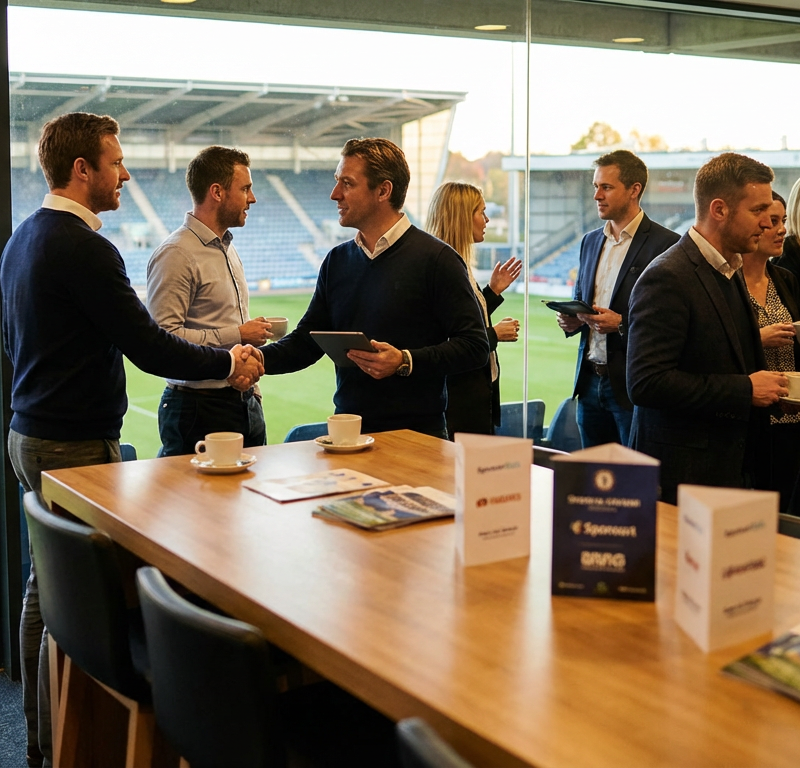
- 08:15 – "Elevator pitches": All participants get 45 seconds to present their company and what they are looking for right now.
- 08:45 – Structured networking at the tables based on a concrete topic.
- 09:15 – Wrap-up and thank you for today.
Step 3: Create engagement before, during, and after individual events
Engagement is about keeping the network alive, even when there are no meetings. The more involved the sponsors feel, the higher their loyalty to the club.
Before the event: Create expectation
Send invitations out well in advance (ideally 4-6 weeks before) and follow up with a participant list 3 days before the meeting starts. When sponsors can see who else is coming, they can prepare for who they want to talk to. This increases the likelihood that they will prioritize showing up.
During the event: Be an active connector
As a facilitator, you don't necessarily have to speak the most yourself. You should spend your time "connecting" people. If you see a participant standing alone, lead them to a group and introduce them. Your role is to be the "icebreaker" who makes networking easy.
After the event: Document and follow up
Send a quick thank-you email the day after with a brief summary of the most important points or links to the speaker's slides. Take photos along the way and share them on LinkedIn or the club's social media (remember to tag the companies!). This gives the sponsors exposure and shows the world that your network is active and attractive.
Step 4: Professionalization with the right tools
As your network grows from 10 to 50 or 100 members, the administration becomes heavy. Manual handling of registrations in Excel sheets and invoicing via email can kill any initiative. Here, it is essential to use digital tools to automate processes.
Good systems can help you with:
- Invitations: Automatic invitations directly to the sponsors' inboxes.
- Registrations: An easy overview of who is coming, who has declined, and who hasn't responded.
- Communication: The ability to send messages to all participants or specific segments with one click.
- Sponsor overview: A digital directory where sponsors can find each other's contact information.
Step 5: Targeting and following up on value
To ensure the long-term survival of the network, you must be able to prove the value to the members. Once a year, you should conduct a small survey. Ask them directly: "Have you gained new customers through the network?", "Have you found new suppliers?", and "How satisfied are you with the professional content?".
If the numbers show that sponsors are actually doing business with each other, you have the strongest sales argument in the world to attract new sponsors. A membership in your sports club suddenly becomes not an expense, but an investment with a measurable return (ROI).
Handling difficult times and low turnout
Are you experiencing declining engagement? It is perfectly natural for a network to lose momentum. Here, it is important to shake things up. Try moving the location, changing the time from morning to after-work, or introducing a trending theme – such as sustainability or artificial intelligence in small businesses. The most important thing is that you listen to the participants and dare to adjust the concept.
Summary: The road to a strong club network
Creating value through networking and events in a sports club is about moving from being a passive recipient of sponsorship funds to being an active facilitator for local business growth. It requires:
- A clear concept and a structured agenda.
- Active facilitation during the meetings themselves.
- Digital support for administration and communication.
- Ongoing evaluation of the business value for the sponsors.
When your events become the meetings that local business people hate to miss, you have created a fundamentally stronger economy for the club – regardless of whether the results on the pitch fluctuate.