Optimizing Matchday Revenue Through Ticket Sales
For many sports clubs in Denmark, from the 2nd division in football to the Metal Ligaen in ice hockey, ticket sales are often viewed in isolation as gate income. However, for the professional club leader, the ticket is merely the first touchpoint in a complete economic value chain. The reality is that a ticket sold for 100 DKK is often the prerequisite for an additional spend at the concession stand of 60-80 DKK.
Optimizing matchday revenue through ticket sales therefore requires a shift from "selling access" to "managing flow and consumption." This article reviews the operational steps that ensure your ticketing system doesn't just validate barcodes but functions as an engine for the club's overall liquidity.
The link between ticket types and secondary spend
When we talk about revenue optimization, it is crucial to look at "Secondary Spend"—the amount a spectator spends at the club beyond the ticket price itself. Data from Danish divisional clubs often shows that season ticket holders have a lower average transaction value at the kiosk per visit than single-ticket guests, but in turn, they visit the stadium 3-4 times as often. The challenge is to increase their spending through technical integrations.
Cashless integration and prepaid balances
By integrating the ticketing system with the club's POS system (point of sale), you can introduce concepts such as "tickets with built-in value." A concrete example is a "Family Ticket" where 50 DKK is loaded for use at the kiosk directly on the barcode. This removes friction at payment and increases the likelihood that the family will buy for more than the 50 DKK once they are at the counter.
| Ticket Type | Avg. Ticket Price (DKK) | Avg. Secondary Spend (DKK) | Total Value per Match |
|---|---|---|---|
| Standard Single Ticket | 100,- | 65,- | 165,- |
| Season Card (per match) | 45,- | 55,- | 100,- |
| VIP/Partner | 0,- (Sponsorship) | 120,- (Extra beverages) | 120,- |
| Package Deal (Ticket + Menu) | 145,- | 25,- (Extra purchases) | 170,- |
System selection and fee structures in the Danish market
The choice of platform has a direct impact on your bottom line. In Denmark, the market is dominated by players like TicketCo, Venue Manager, and Eventim, but many smaller clubs also use solutions like Holdsport or Place2Book. When optimizing revenue, you must be particularly aware of who owns the transaction fee.
Understanding fee models
Some systems take a fixed percentage (typically 2-5%), while others take a fixed fee per ticket (e.g., 5-10 DKK). If your average ticket price is low, e.g., 50 DKK for youth tickets, a fixed fee of 10 DKK can eat 20% of the revenue. Here, you should negotiate a model where the fee is applied to the buyer ("customer pays fees"), so the club's advertised price equals the club's income.
Data ownership as a growth factor
It is a critical mistake to use a system where you do not own the customer data. If you cannot pull a list of everyone who bought a ticket for the local derby last year, you cannot target your marketing for the next big match. Optimization is about reducing "Cost Per Acquisition" (CPA) by reactivating existing customers via email or SMS rather than expensive Facebook ads.
Operational handling of 'Seat Release' and no-shows
A major problem in Danish clubs with many season ticket holders or fixed sponsor seats is "empty seats at a sold-out stadium." This happens when season ticket holders fail to show up without releasing their seats. This hurts revenue on two fronts: you cannot sell the ticket to someone else, and you lose the potential kiosk sale.
Implementing incentives
To optimize revenue, the club should implement a digital "Seat Release" system. Here are three concrete measures:
- Points system: Season ticket holders earn points for merchandise or future discounts every time they release their seat at least 24 hours before kick-off.
- "Scan-in" requirement: If a holder fails to show up three times in a row without releasing the seat, they lose the right to renew their season card at a discount.
- Resale: Enable season ticket holders to sell their seat for a specific match, where the club takes a small administration fee but pays out the rest as credit for the club's webshop.
Pricing: From static to strategic
Many clubs set their ticket prices at the general meeting or before the season starts and keep them fixed. This is a lost opportunity for optimization. A match against the league leaders on a Saturday afternoon has a higher market value than a Tuesday match in the rain against the bottom team.
Differentiation based on demand
Consider dividing your matches into categories (A, B, and C). An A-match (local rivalry) costs 150 DKK, while a C-match costs 75 DKK. This maximizes income on popular days and ensures a minimum number of spectators on difficult days, keeping kiosk revenue stable.
| Category | Opponent/Time | Adult Price | Focus Area |
|---|---|---|---|
| Category A | Top-3 opponent, Weekend | 150 DKK | Maximizing ticket revenue |
| Category B | Mid-table team, Friday/Sunday | 100 DKK | Balance between volume and price |
| Category C | Bottom team, Weekday | 75 DKK | Fill the stadium for kiosk sales |
The role of volunteers in access control
Optimization is also about cost management. If access control is too heavy and requires too many paid guards or complex equipment, it eats into the profit. In smaller clubs, volunteers staff the entrances. Here, the technology must be extremely simple.
Using specialized scanners instead of smartphones can in some cases increase throughput by up to 50%. If a volunteer can scan 10 people per minute instead of 5, you can halve the number of open gates and thus reduce the need for manpower. It is important that the system works offline if the local Wi-Fi at the stadium fails under load.
Upselling in the queue
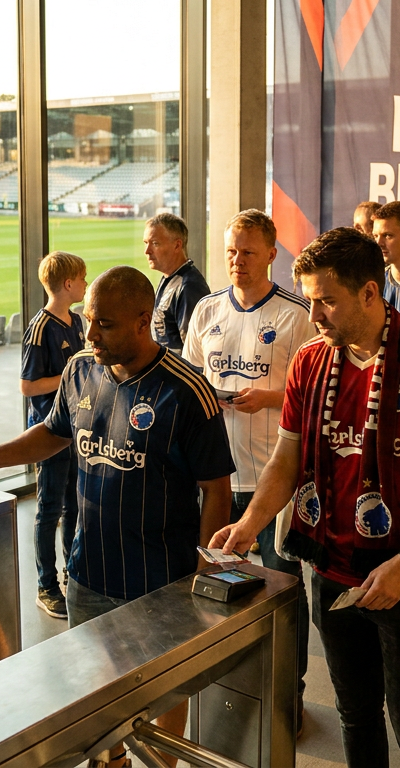
Waiting time at the entrance is a barrier to revenue. If people stand in line for 15 minutes to get in, they have 15 minutes less to shop at the kiosk before kick-off. Optimizing matchday revenue through ticket sales therefore starts with lightning-fast scanning. Consider placing "mobile units" (volunteers with a crate of beer or water) along the queue, where people can pay with MobilePay while waiting to be scanned in.
FAQ: Optimizing Ticket Sales
What is the biggest mistake clubs make with ticket sales?The biggest mistake is the lack of data collection. Many sell tickets "anonymously" at the entrance (cash or MobilePay without registration). Without an email or phone number, you cannot market the next match directly to the customer, making every match a new, expensive acquisition process.
How much does the ticket price matter for total sales?Price is often less important than the experience and accessibility itself. A price increase of 20 DKK rarely scares away loyal fans, but poor logistics (long queues at the entrance or kiosk) can cause people to stay away next time.
How do we best handle free tickets for the youth department?Free tickets should always be issued as a "0-DKK ticket" via the system. This gives you data on who is coming and teaches young people (and their parents) to use the club's digital platform. At the same time, you get precise figures on actual attendance to use for sponsors.
Is it worth investing in an expensive ticketing system for a small club?The investment should be measured against time savings and upselling potential. If a system automates the distribution of match info and handles discount codes for sponsors, it frees up hours for volunteer management that can be used for sponsor sales instead.
Frequently Asked Questions
What is 'secondary spend' in relation to sports ticket sales?
Secondary spend is the amount a spectator spends at the club beyond the ticket price itself, typically on food, drinks, and merchandise. Revenue optimization involves seeing the ticket as a first touchpoint that enables additional spending at stands, often 60-80 DKK per guest.
How can integration between the ticketing system and POS increase revenue?
By integrating the ticketing system with the club's cash registers, you can sell tickets with built-in value. For example, a family ticket could include 50 DKK for the kiosk directly on the barcode. This removes payment friction and increases the likelihood that the customer will spend more than the prepaid amount.
Why is data ownership critical for the growth of sports clubs?
If the club does not own customer data from ticket sales, every match becomes a new and expensive acquisition process. By owning email addresses and purchase history, clubs can significantly reduce their marketing costs by reactivating existing customers directly via email or SMS instead of expensive ads on social media.
What is 'Seat Release', and how does it benefit the club's finances?
Seat Release is a system where season ticket holders release their seat if they cannot attend. This prevents empty seats in an otherwise sold-out stadium, allowing the club to resell the ticket and secure vital kiosk sales from a new spectator that would otherwise have been lost.
Read more: CRM for sports clubs
See also
Read more: CRM til sportsklubber