Managing Technical Infrastructure for Ticket Sales in the Club
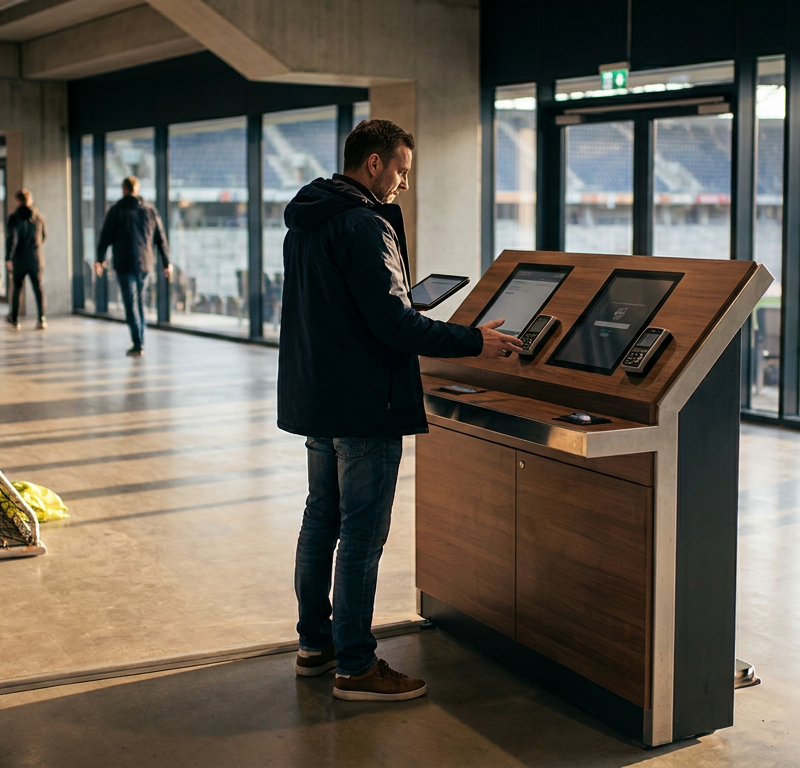
When a sports club professionalizes its ticket sales, focus often quickly shifts to marketing and pricing. However, the most critical point for the actual execution is the underlying technical infrastructure. If the scanning system fails at the entrance, or the network collapses 20 minutes before kick-off, the club loses not only revenue at the stalls due to queuing but also the trust of the spectators.
Managing technical infrastructure for ticket sales requires a structured approach to hardware, connectivity, and data validation. This guide covers the technical requirements that ensure your tickets, season cards, and event tickets can be validated quickly and flawlessly, regardless of the load on the stadium.
Hardware Choice: Scanners, Printers, and Mobile Devices
The choice of hardware defines how quickly you can move people through the entrances. An average spectator expects to spend a maximum of 15-20 seconds on the scanning process itself. If the equipment is too slow, bottlenecks quickly arise.
Professional Handheld Scanners vs. Smartphones
Many smaller clubs start by using volunteers' own smartphones to scan tickets via an app. While this is inexpensive, it involves risks such as lack of battery capacity, poor cameras in low light, and lack of durability in rainy weather. Professional 2D scanners with dedicated laser heads can read codes from a mobile screen in under a second, even at low brightness or with scratches on the screen.
| Device Type | Advantages | Disadvantages | Application |
|---|---|---|---|
| Smartphones (BYOD) | No acquisition cost | Slow focusing, battery issues | Small events, few spectators |
| Industrial Handhelds | Fast scanning, rugged construction | Higher unit price | Main entrances, high frequency |
| Fixed Scanners | Self-service possible | Requires fixed installation and power | Turnstiles, permanent stadium facilities |
Network Architecture and Redundancy
The biggest technical source of error in ticket sales is a missing or unstable internet connection. A ticketing system must be able to validate in real-time whether a ticket has already been used to avoid fraud with copied tickets. This requires a stable connection to the central database.
Bandwidth and Stability Requirements
Even though a single validation uses very little data (a few kilobytes), many simultaneous requests create pressure on the connection. It is crucial to separate the administrative network (used for ticket sales and stalls) from the public spectator Wi-Fi. If spectators are uploading videos to social media on the same network that scanners use, you risk validation taking several seconds per ticket.
Offline Functionality
Your technical setup must be able to handle a total network failure. Modern infrastructure should support a "local synchronization" where scanning devices download a copy of all sold tickets before the match starts. If the connection drops, the system switches to offline mode and saves scanning data locally, which is then synchronized when the connection is restored. This prevents the entrances from coming to a standstill.
Integration with Access Control (Turnstiles)
At larger facilities, the management of technical infrastructure is often integrated directly with physical turnstiles. Here, the software must send a signal to a relay box that unlocks the mechanism. This requires wired connections (Ethernet) rather than Wi-Fi to ensure minimal latency.
In this setup, a local server or a controller device is necessary to manage communication between the cloud and the physical hardware. Maintenance of these devices should be part of the club's quarterly operational checks, where sensors are cleaned and mechanical parts are lubricated.
Data Security and Validation Logic
Infrastructure is not just about hardware, but also about the rules governing validation. Correct setup ensures protection against misuse and technical errors.
- Anti-passback: The system must prevent the same ticket from being scanned in twice within a short period, or a ticket being scanned out and in again without permission.
- Zone Management: The infrastructure must be configured so that a ticket for Grandstand A does not grant access at the entrance to Grandstand B. This requires each scanning device to be assigned to a specific logical zone in the system.
- Season Card Prioritization: Season cards require a different validation profile than single tickets, as they are often linked to a specific person with a photo ID that can pop up on the scanner screen.
Operational Plan for Match Days
Technical success depends on preparation. A technical manager should review the following points 2 hours before the gates open:
- Battery Check: All mobile devices must be 100% charged and have access to power banks.
- Connection Test: Perform a test scan with a "dummy ticket" at every single entrance to confirm that data is flowing to the system.
- Synchronization: Force a manual synchronization of the database to all handheld devices so the latest ticket purchases are registered.
- Print Station: Have a functioning label or ticket printer ready in the ticket office to handle faulty tickets or forgotten season cards.
Handling Faulty Tickets (Troubleshooting)
Even the best infrastructure encounters problems. Typical scenarios include cracked mobile screens on fans that make scanning impossible, or tickets bought at the very last second that haven't synchronized to the scanner yet.
Here, the technical infrastructure must support manual lookup. Scanning staff must have "super-user" access or a dedicated terminal nearby where they can search for orders by name, email, or phone number. This requires a stable tablet with access to the club's backend system, located at each main section.
Future-Proofing: NFC and Contactless Access
We are seeing a movement away from QR codes towards NFC (Near Field Communication), as we know it from payment cards and Apple Wallet. The advantage of NFC is that it often works faster and does not require the user to turn on the screen or turn up the brightness. When upgrading hardware, clubs should consider scanners that support both 2D barcodes and NFC to be prepared for the next generation of digital season cards.
Cost Considerations for Upgrading
When the club needs to invest in new infrastructure, you should look at the total cost of ownership (TCO) over a 3-5 year period rather than just the purchase price.
| Investment | One-time Cost | Ongoing Operation | Expected Lifespan |
|---|---|---|---|
| Cloud-based ticketing system | Low/None | Subscription or fee per ticket | Continuously updated |
| Industrial scanners (5 units) | 10,000 - 15,000 DKK | Software license / MDM | 4-6 years |
| Dedicated Wi-Fi Point-to-Point | 5,000 - 8,000 DKK | Minimal | 5 years |
Conclusion on Technical Set-up
Managing technical infrastructure for ticket sales is about eliminating uncertainty. By separating network traffic, choosing dedicated hardware over consumer electronics, and ensuring strong offline procedures, you create the foundation for a seamless match day experience. It reduces frustration for both volunteers and spectators and ensures that the club's data is accurate when accounts are settled afterwards.
FAQ on Technical Infrastructure for Ticket Sales
How many scanners do we need per 1,000 spectators?
As a rule of thumb, you should have at least 2 scanners per entrance. For 1,000 spectators, 3-4 active scanners are recommended to keep waiting times under 5 minutes during peak periods (typically 15 minutes before kick-off).
What do we do if the power goes out in the whole area?
Ensure that your scanning devices run on battery and that your network routers are connected to a UPS (Uninterruptible Power Supply). A 4G/5G router as a backup can keep the system running even if the fixed internet and power fail.
Can we use regular laser scanners for mobile tickets?
No, traditional 1D laser scanners often cannot read from reflective mobile screens. You need 2D image scanners (imagers) that can decode QR codes and barcodes directly from screen surfaces.
How do we ensure that scanning data is GDPR compliant?
Ensure that scanning devices do not store personally identifiable data locally after synchronization is complete, and that access to scanning apps is protected with individual logins for volunteers, so you can see who scanned what in case of errors.
Frequently Asked Questions
Why should clubs choose professional scanners over smartphones?
Although smartphones are cheap, they often create bottlenecks due to slow focusing and poor battery life. Professional 2D scanners with laser heads can read tickets in under a second, even in low light or with scratches on the screen, ensuring a fast flow and minimizing queues at the entrance.
How do you ensure stable internet for ticket sales at a stadium?
To avoid crashes, the administrative network for scanning and stalls should always be separated from the public spectator Wi-Fi. During high loads, spectators' data usage can otherwise slow down validation. Furthermore, the infrastructure should support offline mode, where a local copy of the database ensures operation if the connection to the cloud is interrupted.
What are the most important technical preparations on a match day?
Two hours before kick-off, the technical manager should conduct a battery check and perform test scans at all entrances. It is crucial to force a manual synchronization of all sold tickets to the handheld devices and ensure that a print station is ready to handle defective tickets or forgotten season cards.
How does zone management and anti-passback work in the ticketing system?
Zone management technically ensures that a ticket only grants access to the correct grandstand by assigning scanners specific logical zones. Anti-passback logic prevents misuse by blocking the same ticket from being scanned in multiple times in quick succession, protecting the club's revenue against ticket duplication.
Read more: CRM for sports clubs
Also read
Read more: CRM til sportsklubber