Operational Management of Ticket Categories and Access Control
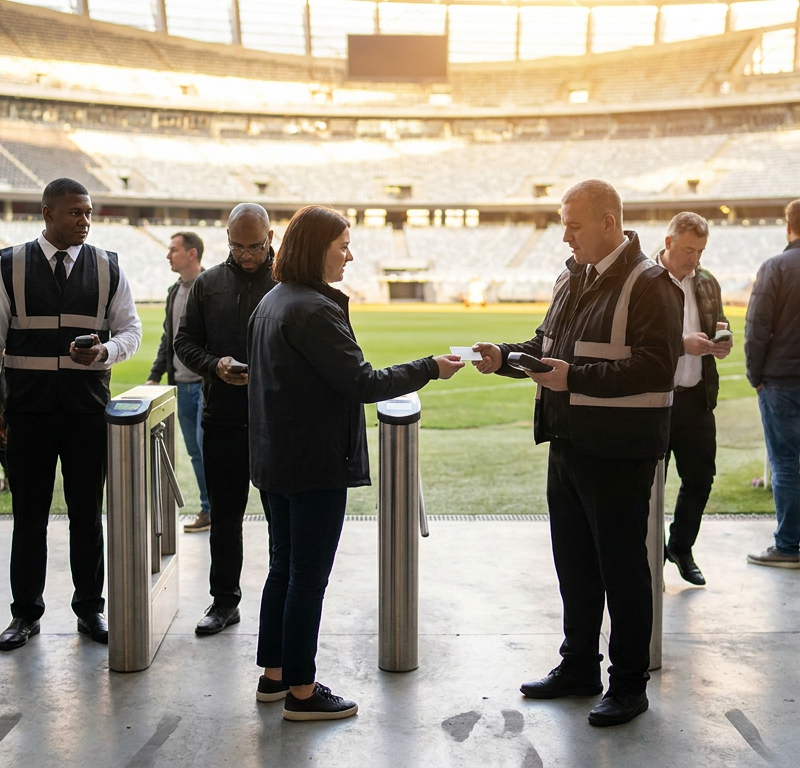
Effective ticket sales are about more than just selling an access-granting barcode. For the club leader, it is a matter of balancing maximum revenue with smooth logistics at the stadium gates. If your ticket categories are unclear, or your access control bottlenecks 15 minutes before kickoff, the club loses both money and spectator loyalty.
This article reviews the operational aspects of how you define the right categories, price them in relation to capacity, and ensure that the technology behind access control supports professional execution.
Structuring Ticket Categories: From Standard to Premium
One of the most common mistakes in small and medium-sized clubs is having too few ticket categories. If you only offer "Adult" and "Child," you miss the opportunity to segment your audience according to willingness to pay and need for comfort. Each category must have a clear definition that justifies the price difference.
Consider the following differentiation to maximize the value of every square meter at your facility:
| Category | Description | Target Audience | Pricing Strategy |
|---|---|---|---|
| Standard Standing | Access to general standing terraces without fixed seats. | Price-sensitive fans, youth, and active fans. | Lowest price point (Index 100). |
| Covered Seating | Guaranteed seat with protection from wind and weather. | Families and older spectators. | Index 150 - 180 of standard. |
| Premium/VIP Lite | Padded seat, access to a closed lounge without full catering. | Small business owners and loyal fans. | Index 250 - 300 of standard. |
| Away Section | Secluded area dedicated to visiting fans. | Traveling spectators. | Equivalent to standard standing (legal requirement in certain leagues). |
Season Tickets as a Foundation for Liquidity
The season ticket is not just a ticket to all matches; it is insurance against bad weather and sporting adversity. Operationally, the season ticket must be treated as an independent category with unique rights in your access control system. By selling season tickets early in the season, you secure liquidity before the variable costs of match execution truly kick in.
Pricing of Event Tickets and Dynamic Factors
The ticket price should never be static throughout a whole season. A local derby against a main rival has a higher market value than a Tuesday match against the bottom team. By using differentiated pricing, you can manage demand.
Scenario: A club with a capacity of 2,000 seats normally sees an attendance of 800. For top matches, interest increases. Here, the price of event tickets should be adjusted up by 20-30%, while subscribers (season ticket holders) still have their fixed access. This creates an incentive to buy a season ticket, while the club reaps the benefit of the most popular matches.
Early-bird and Last-minute Logic
To ease administrative pressure on match day, pricing should motivate online pre-sales. A price difference of, for example, 20 DKK between online purchases and purchases at the ticket booth at the entrance moves noticeable volume away from the stadium queue. This reduces the need for staff for cash handling and manual transactions.
Operational Access Control: Technology and Flow
Once the tickets are sold, the next critical phase begins: access control. A bad experience at the entrance can overshadow a good match. The system must be able to validate tickets in real-time to prevent abuse and provide the club with precise data on when people arrive.
Choosing a Scanning Method
There are three primary methods for access control, depending on the club's size and infrastructure:
- Smartphone-based scanning: Inexpensive solution where volunteers use their own or the club's phones with an app. Requires stable 4G/5G or Wi-Fi.
- Professional handheld scanners (PDA): More robust units with dedicated laser scanners. Better for fast processing and reading screens with low brightness.
- Turnstiles: Fully automated solution. High initial cost but saves labor hours in the long run.
Capacity Calculation at Entrances
To avoid bottlenecks, you must know your "throughput"—that is, how many people one scanner unit can handle per minute. An experienced steward can typically scan 10-12 people per minute, provided that spectators have their tickets ready.
If you expect 1,200 spectators within the last 30 minutes before kickoff, the calculation is as follows:
1,200 spectators / 30 minutes = 40 spectators per minute.
40 spectators per minute / 10 scans per unit = 4 scanners/stewards.
Data Collection and Real-time Monitoring
Operational management of ticket categories only makes sense if you use the data along the way. Modern systems provide you with a live dashboard where you can see how many of the sold tickets have been scanned in.
Why is this important?
- Staffing optimization: If 90% of the audience is inside 10 minutes early, you can move stewards to the concessions or other service functions.
- Safety: In emergencies, you need to know exactly how many people are at the facility, distributed across the different sections (categories).
- Sponsor reporting: You can document precise exposure to sponsors by showing actual attendance figures rather than just tickets sold.
Handling Faulty Scans
Problems will always arise at access control: expired season tickets, tickets purchased for the wrong date, or phones without power. Operationally, you must have a "Troubleshooter Station" (Help Desk) away from the scanning line itself.
When a scanner lights up red, the steward should immediately direct the person to a dedicated staff member with a computer or tablet with full access to the ticketing system. This ensures that the queue behind does not stop while a single case is being resolved.
Typical Error Scenarios and Solutions
| Problem | Solution Model | Preventive Action |
|---|---|---|
| Ticket already scanned | Check history in the system. Could be a duplicate print. Deny entry or require re-purchase. | Clearly state "only one scan per barcode" on the ticket. |
| Unreadable screen (scratches/light) | Enter barcode number manually or print a replacement ticket. | Encourage fans to turn their phone brightness to maximum. |
| Wrong category (e.g., child on adult) | Charge the difference at the Help Desk before entry. | Use different sound signals or color codes in the scanner for each category. |
FAQ on Ticket Categories and Access Control
How do we best differentiate between adult and child tickets?
It is recommended to set a fixed age limit (e.g., under 16 years). In the access control system, child tickets should produce a different sound signal or a different color on the scanner screen, so the steward can quickly spot if an adult attempts to use a child ticket.
Is it necessary to scan at the exit?
If you allow spectators to leave the stadium and return (e.g., at halftime), it is essential to scan them out. Otherwise, their ticket will appear as "already scanned" when they try to enter again. This is called "anti-passback" logic.
What do we do if the internet goes down at the stadium?
You should always choose a system that supports offline scanning. Here, the scanning units store data locally and synchronize with the server as soon as the connection is restored. Always have a printed list of season ticket holders as an absolute backup.
How do we avoid fraud with PDF tickets?
The only effective method is real-time scanning against a central database. Once a barcode has been scanned once, it is immediately invalidated in the system, regardless of how many copies have been printed.
Should we have separate queues for season tickets?
Yes, if possible. It is part of the value of a season ticket to get "fast track" access. It reduces frustration for your most loyal fans and makes it easier to manage the flow for those who need to buy or get help with their tickets.
Frequently Asked Questions
Why should a sports club operate with several different ticket categories?
By differentiating between categories such as standard, premium, and VIP, the club can segment the audience by willingness to pay and need for comfort. This maximizes revenue per square meter and ensures that pricing reflects the added value, which is more effective than simply offering a standard adult or child ticket to everyone.
How can differentiated pricing optimize the club's earnings?
Dynamic pricing allows the club to raise the price by 20-30% for popular local derbies, while lower prices for weekday matches stimulate demand. At the same time, a price difference between online pre-sales and physical sales at the entrance creates an important incentive that reduces stadium queues and lowers the club's administrative costs.
What significance does the choice of technology have for access control?
The choice between smartphone apps, handheld scanners, or turnstiles determines the flow at the entrances. Professional scanners ensure faster processing of queues, as they handle low brightness on mobile screens better. An efficient system provides real-time data, which is crucial for safety and enables optimization of staffing by moving stewards to stalls after kickoff.
How are errors at the entrance handled without creating bottlenecks?
To ensure a fluid flow, the club should establish a dedicated Help Desk away from the scanning line itself. When a scanner fails due to an expired card or a defective screen, the person is immediately directed away from the queue. This allows the other fans to pass unhindered while the error is resolved separately.
Read more: CRM for sports clubs
See also
Read more: CRM til sportsklubber