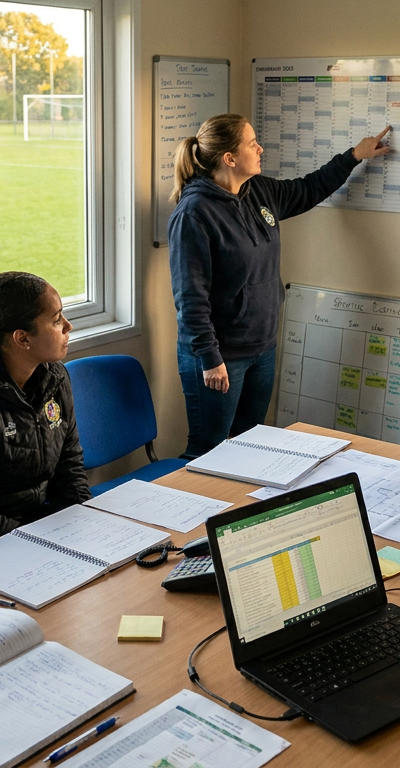
Administrative Annual Cycle for Sports Clubs: A Guide to Stable Operations

Club administration is largely about due diligence. Many clubs find that administrative tasks land as small crises on the board's table because deadlines for member reporting, applications for facility grants, or VAT refunds catch volunteer leaders off guard. By establishing a fixed administrative annual cycle for sports clubs, you can shift the focus from firefighting to long-term management.
Why an administrative annual cycle is the foundation of club operations
An administrative annual cycle is not just a calendar; it is a management tool that ensures knowledge transfer. In sports clubs, where turnover on the board and among volunteers often occurs at short intervals, the risk of losing historical knowledge is high. If the outgoing treasurer is the only one who knows when to apply for Section 4 grants under the Danish Non-formal Education Act (Folkeoplysningsloven), the club is vulnerable during a change of guard.
When administrative processes are scheduled, everyone involved knows exactly when their efforts are required. This reduces stress for volunteers and ensures that the club does not miss out on vital income due to missed deadlines.
Critical deadlines in the club's calendar
There are a number of statutory and municipal deadlines that every Danish sports club must navigate. Below are the most important points that should be included in your annual cycle.
Member Reporting (CFR) – January
Every year, sports associations must report their membership numbers to the Central Association Register (CFR). The figures are used for the distribution of lottery funds and other public grants. The deadline is typically January 31st. An error here can cost the club thousands of kroner in lost support.
Facility Grants and Activity Grants – November
Although exact dates vary from municipality to municipality, many administrations operate with a deadline around November 15th for applications for facility grants for the coming year under the Non-formal Education Act. If you use your own or rented premises, this application is crucial for the club's liquidity.
VAT Refunds for Sports Associations
Non-profit sports associations can apply for partial VAT compensation. This is often an overlooked source of income. The application deadline is typically in July for the preceding financial year. To apply, the club must have precise breakdowns in its accounts between VAT-liable activities (e.g., kiosk sales) and non-VAT-liable activities (e.g., membership fees).
Structure of the administrative annual cycle
To make the work manageable, the year can be divided into quarters. Below is an overview of typical tasks in a medium-sized Danish sports club:
| Quarter | Focus Area | Key Tasks |
|---|---|---|
| Q1 (Jan-Mar) | Accounts & General Meeting | CFR reporting (Jan 31), annual accounts finalized, holding the general meeting, membership fee collection for the spring season. |
| Q2 (Apr-Jun) | Planning & Evaluation | Sponsor review, budgeting for the next season, recruiting coaches for the autumn. |
| Q3 (Jul-Sep) | Season Start & Refunds | Application for VAT refund, start of member management, invoicing sponsors, checking insurance. |
| Q4 (Oct-Dec) | Grants & Operations | Application for facility grants (typically Nov 15), obtaining child protection certificates, planning volunteer parties. |
Financial management and limit amounts
A significant part of club administration is navigating the financial frameworks for volunteers. Many boards are in doubt about how much they can give their coaches and leaders in tax-free allowances.
Tax-free allowance for volunteers
For an allowance to be tax-free, the recipient must be an unpaid volunteer. There are fixed rates that are adjusted annually. If a volunteer receives more than these rates, the entire amount is generally taxable as B-income.
In 2024, the rates for tax-free allowances are:
- Expense allowance (administration, telephone, internet): Up to DKK 2,450 per year.
- Allowance for purchase, washing, and maintenance of clothing: Up to DKK 2,450 per year.
It is important to note that you cannot receive both as full amounts if they cover the same actual expenses. The club must have a clear policy for who is eligible for these rates to avoid problems with SKAT (Danish Tax Agency) during a potential audit.
Child Protection Certificates – A fixed routine
It is a legal requirement for sports clubs to obtain child protection certificates for all coaches, instructors, and leaders who have direct and regular contact with children under 15. This should not be an ad hoc task. Include it in the annual cycle twice a year – typically in August and January – so new coaches are always checked before the season starts.
Digitalization of administrative processes
Manual processes in Excel sheets or ring binders are vulnerable. By using dedicated systems for club management, you can automate large parts of the administrative annual cycle.
Time savings through automation
Where manual handling of 200 members typically takes a treasurer 15-20 hours a month in connection with billing and reminders, an integrated system can reduce this time spent to under 2 hours. The time saved can instead be used to develop the club or cultivate sponsors.
Specific benefits of digitalizing administration include:
- Automatic fee processing: The system sends invoices and reminders for missing payments, minimizing arrears.
- Data validity: Members update their own addresses and email information, ensuring correct lists for CFR reporting.
- Financial overview: Integration between the member system and accounting software ensures the treasurer always has a real-time view of liquidity.
Sponsor management in the annual cycle
Sponsorship work is often forgotten in daily operations until funds are lacking. Professional administration implies that sponsors are handled with the same systematic approach as members.
Incorporate these three phases into your annual cycle:
- March-April: Evaluation of current agreements. What has the sponsor gained from the collaboration? Send a short status report.
- May-June: Renegotiation and new sales. This is when companies set their budgets for the coming year.
- August: Implementation of new signs, logos on clothing, and website updates.
FAQ: Frequently asked questions about club administration
What happens if we miss the deadline for CFR reporting?
If you miss the January 31st deadline, the club may lose its basic grant from lottery funds for that year. Furthermore, it can affect your status as an approved non-formal education association in the municipality, which may result in the loss of facility grants.
Can we give our coaches a tax-free gift?
Yes, but the rules are strict. Small gifts of a trivial nature (e.g., a bottle of wine or a Christmas basket) are normally tax-free, as long as the total value of gifts from the club does not exceed DKK 1,300 (2024 level) in a year. Cash is always taxable.
How long should we keep accounting vouchers?
According to the Danish Bookkeeping Act, accounting material must be kept for 5 years from the end of the financial year the material relates to. This also applies to digital vouchers. Ensure you have a fixed routine for archiving so the material is available in case of a change in auditor or municipal supervision.
How do we ensure handover during a change of chairmanship?
The best tool is the administrative annual cycle combined with an "Operations Manual." This describes passwords for systems, contact persons in the municipality, and fixed routines for, e.g., key distribution and child protection certificates. This ensures continuity, regardless of who holds the positions.
Conclusion on structured club operations
Effective club administration does not necessarily require a professional background in management, but it does require structure. By implementing an administrative annual cycle, you create a self-running organization where the most important tasks are completed on time, and where volunteers do not burn out under the weight of unforeseen deadlines. Start by plotting municipal deadlines into a shared calendar, and then build your own internal routines on top.
Frequently Asked Questions
Why is an administrative annual cycle important for a sports club?
An administrative annual cycle serves as a management tool that ensures due diligence and knowledge transfer in sports clubs. By scheduling deadlines for grants, member reporting, and VAT refunds, the board avoids critical errors during leadership changes. It shifts the focus from acute firefighting to long-term planning and secures the club's financial foundation through fixed routines.
Which deadlines are the most important in the club's administrative calendar?
Key deadlines include member reporting to CFR (typically January 31st) to secure lottery funds, and applications for facility grants under the Non-formal Education Act (often mid-November). Additionally, July is central for applying for VAT refunds for the previous year, which requires precise separation of VAT-liable and non-VAT-liable activities in the accounts.
What rules apply to tax-free allowances for volunteers in 2024?
Unpaid volunteers can receive tax-free allowances to cover expenses. In 2024, the rates are up to DKK 2,450 for administrative, telephone, and internet costs, and up to DKK 2,450 for the purchase and washing of clothes. If higher amounts are received, the entire sum becomes taxable as B-income, unless it concerns documented out-of-pocket expenses based on receipts.
What are the requirements for obtaining child protection certificates in sports associations?
It is a legal requirement for sports clubs to obtain child protection certificates for all coaches and leaders who have direct and regular contact with children under 15. To ensure compliance, the task should be fixed in the annual cycle twice a year, typically at the start of the season in January and August, so new volunteers are always checked before starting.
Read more: CRM for sports clubs
See also
Read more: CRM til sportsklubber