Operational Management of Sports Clubs: A Complete Administrative Checklist
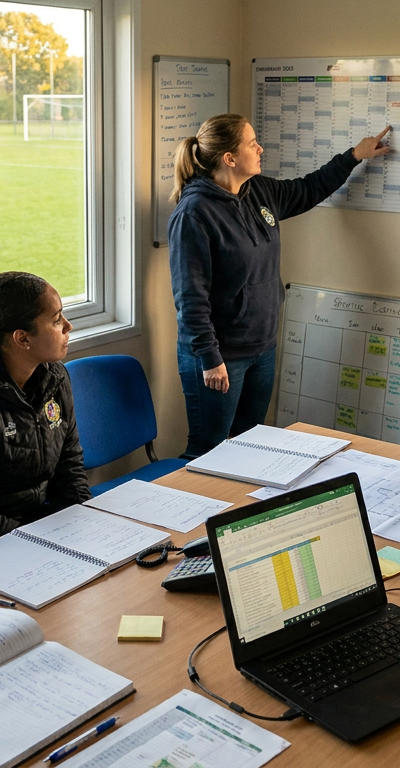
Effective club administration is rarely about grand visions in the boardroom, but about the small, repetitive tasks that keep the association running smoothly. When the operational management of a sports club fails, it is immediately felt in the form of missing pitch times, unpaid bills, or legal issues regarding child protection certificates.
This article reviews the critical points in the club's engine room that ensure management can focus on sporting development rather than firefighting. We dive into legal requirements, insurance matters, and the practical coordination of volunteer resources.
Mandatory Child Protection Certificates and Consequences of Neglect
Obtaining child protection certificates (børneattester) is not just a moral obligation; it is a legal requirement for all associations that have coaches, instructors, or leaders with direct contact with children under the age of 15. According to the Danish Social Education Act (Folkeoplysningsloven), municipalities are obliged to supervise that associations comply with this.
Many clubs make the mistake of thinking that the certificate only needs to be obtained once. Best practice is to re-obtain certificates every two years or at the start of each season to ensure full documentation. The consequences of non-compliance are direct:
- Loss of subsidies: The municipality can stop the payment of activity subsidies with immediate effect.
- Loss of facility loans: The right to use municipal halls and pitch facilities can be revoked.
- Legal liability: The board can be held personally liable if an incident occurs and the mandatory documentation has not been obtained.
Checklist for Child Protection Certificates
| Action | Frequency | Responsible |
|---|---|---|
| Registration of new coaches in the system | Ongoing | Sports Director/Department Head |
| Request via politi.dk (requires NemID/MitID) | Upon hiring/start | Chairman/Secretary |
| Follow-up on missing consent from coach | After 7 days | Administrative employee |
| Logging of approved certificates (without sensitive personal data) | Ongoing | Secretary |
Insurance in the Association: DIF/DGI vs. Supplementary Coverage
An often overlooked part of operational management is insurance matters. Associations under DIF and DGI are automatically covered by collective insurance at Tryg, but this coverage has limitations that every club leader should be aware of.
Collective insurances usually cover occupational injuries (for volunteers), liability insurance, legal aid, and travel insurance. However, be aware of the following gray areas:
- Equipment and Property: The club's own tools, balls, IT equipment, and furniture are rarely covered by the collective agreement. A separate property insurance policy is required here.
- Directors and Officers Liability: If the board makes financially irresponsible decisions, standard liability insurance does not necessarily cover it. D&O insurance may be necessary in larger clubs.
- Accident Insurance: As a rule, club members are not covered by accident insurance through the club. They must be covered by their own private accident insurance.
Financial Management and Fixed Cost Structures
To ensure stable operations, the treasurer must have a full overview of the fixed expenses that typically hit a sports association. Unforeseen expenses for fines or fees quickly drain the treasury of funds that should have been used for equipment or coach education.
Below are examples of typical operating costs and potential financial traps:
| Expense Type | Estimated Price/Fee | Note |
|---|---|---|
| Hall rental (municipal) | 0 - 250 DKK/hour | Depends on municipal subsidy rules (Folkeoplysningsloven). |
| Fine for no-show (e.g., DBU) | 500 - 2,500 DKK | Increases for repeated instances in the same season. |
| Match protocol and referee fees | 150 - 450 DKK/match | Varies by level and sport. |
| Bank fees (Business account) | 2,000 - 5,000 DKK/year | Often includes fees for Anti-Money Laundering (KYC) checks. |
Liquidity Management in Practice
Many clubs experience "liquidity squeezes" in the months before membership fees are collected. An operational rule of thumb is to have a liquidity reserve corresponding to 3 months of fixed operating costs. This ensures the club can pay referee bills and pitch rental, even if a large sponsor payment is delayed.
Management of Volunteer Resources for Match Days
Operations on the actual match day or tournament day are where the administration becomes visible to members and guests. Instead of relying on ad-hoc agreements in Messenger groups, the club should implement a fixed structure for task distribution.
An effective operational model for volunteers involves a division into "core tasks" and "ad-hoc tasks":
Core Tasks (Require training)
- Match Secretariat/Timekeeping: Errors here can lead to protests and fines from the federation.
- Kiosk Manager: Handling food safety (self-monitoring schemes) and cash reconciliation.
- Tournament Management: Decision-maker in case of conflicts or injuries.
Ad-hoc Tasks (Low threshold)
- Match Sponsor Activation: Setting up roll-ups, handing out flyers, or Social Media updates with match sponsor tags.
- Preparation: Setting up goals, corner flags, or nets.
- Cleanup: Emptying bins and sweeping changing rooms (important to avoid fees from the hall inspector).
Sponsorship Management in Daily Operations
Sponsorships must not end up as passive income where the logo just hangs on a wall. The operational management of sponsorships is about delivery. If the club has promised three posts on Facebook and a logo in the match program, there must be a person responsible for ensuring this actually happens.
Example of match sponsorship operation: For every home game, an "activation manager" is appointed. This person ensures the sponsor gets their post on Facebook at 10:00 AM on match day, that the sponsor's flag is visible at the entrance, and that the sponsor is mentioned over the PA system during goals. This systematic approach makes it possible to document value when the contract needs to be renegotiated.
Digital Infrastructure and Data Discipline
A sports association generates large amounts of data: membership lists, coach contracts, sponsorship agreements, and invoices. If these are scattered across different Excel sheets and private Dropbox folders, the club becomes vulnerable if a key person leaves.
Operational management involves:
- Centralized File Management: All documents must be stored in the association's shared drive.
- GDPR Compliance: Deletion of data on resigned members (typically after 5 years according to the Bookkeeping Act, but immediately for sensitive personal information without relevance).
- Rights Management: Only relevant persons should have access to child protection certificates and bank accounts.
FAQ: Frequently Asked Questions about Club Management
Who is responsible for child protection certificates in the club?
The legal responsibility lies with the board. In practice, an administrative employee or secretary is often appointed to handle the actual collection, but the board must supervise that it happens.
Can we get IT equipment covered through DIF's insurance?
No, DIF's collective insurance generally does not cover theft or damage to the association's own equipment such as laptops, tablets, or sound systems. The association must take out a separate property insurance policy for this.
What do we do if a volunteer is injured during a match?
If the volunteer is performing a task for the association, they are covered by the mandatory occupational injury insurance through the collective agreements in DIF/DGI. The injury should be reported to the insurance company as soon as possible.
Is it mandatory to keep receipts for 5 years?
Yes, according to the Danish Bookkeeping Act, all receipts and accounting material must be kept for 5 years plus the current year. This also applies to digital material.
How do we ensure we don't get fines for missing referees?
The best solution is to have a dedicated referee coordinator who double-checks all match schedules 48 hours before kick-off and has an "emergency list" of local club referees who can step in if federation referees cancel.
Frequently Asked Questions
Why is it important to obtain child protection certificates in sports associations?
It is a legal requirement for all associations with coaches or leaders who have contact with children under 15. Non-compliance can lead to the loss of municipal subsidies, withdrawal of the right to borrow facilities and halls, and make the board personally liable if incidents occur without the required documentation.
Does the association's collective insurance cover all equipment and furniture?
No, the collective insurances through DIF and DGI typically cover occupational injuries for volunteers and liability insurance, but they rarely cover the club's equipment like balls, tools, and IT equipment. A separate property insurance policy is required to protect the association's assets against theft, fire, or damage in daily use.
How large a liquidity reserve should a sports association have?
A good operational rule of thumb is to have a liquidity reserve corresponding to three months of fixed operating costs. This ensures the association can pay ongoing bills to referees, bank fees, and pitch rentals during periods where major income like membership fees or sponsor payments have not yet been received or are delayed.
What does good digital data discipline involve in a sports association?
Good digital management requires centralized file management on the association's shared drive rather than private folders. This ensures continuity if key persons leave. At the same time, GDPR rules must be followed by deleting data on resigned members after five years according to the Bookkeeping Act, while sensitive personal information without relevance must be deleted immediately.
Read more: CRM for sports clubs
Read also
Read more: CRM til sportsklubber