Ticketing Solutions for Sports Clubs: Manual Setup vs. Integrated Digital System
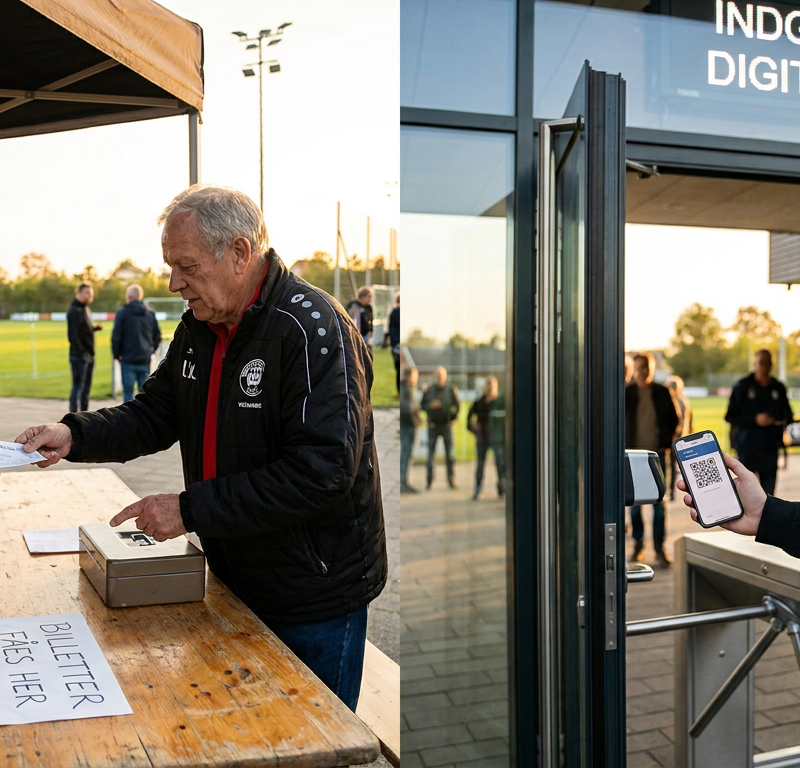
As sports clubs climb through the ranks, a question inevitably arises regarding the handling of spectators: Should we continue with the familiar setup at the entrance, or is the time ripe to invest in a fully integrated ticketing system? The choice often depends on the club's ambitions, the number of volunteers, and the need for professional data collection.
In this article, we compare the two most common ticketing models in Danish sports clubs: The traditional manual setup and the modern, integrated digital system. We look at finances, administration, fan experience, and long-term growth through season cards and event tickets.
The manual setup: Cash, MobilePay, and volunteer efforts
Many smaller clubs start with a model where tickets are sold directly at the entrance on match day. This often involves a physical table, a MobilePay code, and perhaps a paper roll with control numbers. This model has been the standard for decades, but it carries both advantages and significant limitations.
The advantages of the manual model
The biggest advantage is the low barrier to entry. No technical setup, no platform subscription, and no software training are required. It is quick to execute here-and-now, and there are no transaction fees to a ticket provider. For a club with very few spectators (under 100 per match), it can feel like the most manageable solution.
The disadvantages and hidden costs
Problems arise when the club wishes to grow. Manual ticketing creates bottlenecks at the entrance just before kickoff, which diminishes the fan experience. Furthermore, the club misses out on valuable data. When you sell a ticket for cash or via a generic MobilePay transfer, you don't know who the buyer is. You cannot send them an email with information about the next match, and you cannot track whether they are repeat or first-time visitors.
The integrated digital system: Automation and insight
A digital system moves the entire process online. Here, fans purchase their tickets or season cards via the club's website or an app before they even arrive at the stadium. On match day, a QR code is scanned on the phone, and access is secured.
The advantages of digitalization
The most significant advantage is the ability to sell tickets around the clock. This creates a psychological commitment among fans; once you have bought your ticket on Wednesday, the probability that you will show up on Sunday (even if it rains) is significantly higher. Furthermore, the system enables easy administration of season cards, which automatically grant access to all home matches without manual guest list checks.
Costs and complexity
Digital solutions often involve a setup fee, a monthly subscription, or a fee per ticket sold. Additionally, it requires a certain level of technical understanding among the staff or volunteers who set up events in the system. However, this is often offset by the man-hours saved in administration and the increased upsells.
Comparison of ticket prices and revenue potential
How does the choice of system affect the club's bottom line? Let's look at the different parameters that define your economic success with ticketing.
Flexibility in ticket pricing
In the manual system, you often have a fixed price: "50 DKK for adults, 25 DKK for children." It is difficult to differentiate prices without creating chaos at the entrance. In a digital system, you can easily work with tiered pricing. You can offer "Early Bird" discounts, family packages, or dynamic prices for top matches. This is a crucial tool for maximizing earnings per spectator.
Season cards as a liquidity machine
Season cards are the backbone of a healthy club economy because they ensure liquidity early in the season. Manual handling of season cards often involves physical plastic cards, lists at the entrance, and manual invoicing. An integrated system automates all of this. Fans can renew their season cards themselves, and the system keeps track of validity. This eliminates errors and saves the accounting department countless hours.
The fan experience: From queues to convenience
When comparing the two models, the fan experience is where the difference is most noticeable. Modern sports fans expect a frictionless journey from their smartphone to the stands.
The match day experience
In the manual setup, fans risk standing in line for 15 minutes leading up to kickoff while a volunteer counts coins or waits for MobilePay receipts. With digital event tickets, fans are scanned in within seconds. This reduces irritation and gives fans more time at the concession stand or club shop before kickoff, increasing the club's other revenues.
Communication and loyalty
A digital system collects permissions (marketing consent). This means that after the match, the club can send a thank-you email, offer a merchandise discount, or invite them to the next big event. This direct line to customers does not exist in the manual setup, where any contact stops once the ticket is paid for.
Which solution should your club choose?
To make the choice easier, one can set up a quick comparison table based on the club's current situation:
Choose the manual setup if:
- The club has fewer than 50-70 paying spectators per match.
- You primarily play grassroots football/handball without major commercial ambitions.
- You have a very large corps of volunteers who enjoy standing at the entrance and greeting people personally.
Choose an integrated digital system if:
- You have ambitions to grow spectator numbers and your brand.
- You want to build a database of fans for future marketing.
- You want to sell season cards and event tickets for special arrangements (e.g., sponsor lounges or cup matches).
- You want to reduce administrative pressure on your treasurer and volunteers.
Implementing digital ticketing: Taking the next step
If you decide to switch from manual to digital, it is important not just to see it as a technical shift, but as a strategic opportunity. The digital system is not just a ticket machine; it is a source of knowledge.
Example: A club in the 2nd division discovered via their digital data that 40% of their ticket buyers lived more than 30 kilometers away. With this insight, they could target their social media advertising much more accurately and enter into partnerships with local bus lines. Had they continued with manual sales, this insight would never have come to light.
Summary of the comparison
While the manual setup wins on simplicity in the moment, the integrated digital system wins on almost every other parameter: scaling, revenue, data, and fan experience. For clubs that wish to professionalize their setup, the transition to digital tickets and automated season cards is not just a luxury, but a necessity to keep up with developments in modern sport.
Regardless of which model is chosen, it is crucial to have a clear strategy for ticket pricing and to know how to communicate the value of being present in the stands to your fans. The ticket is not just access to a match; it is access to a community.