The Practical Roadmap for Structured Club Administration: From Boardroom to Sideline
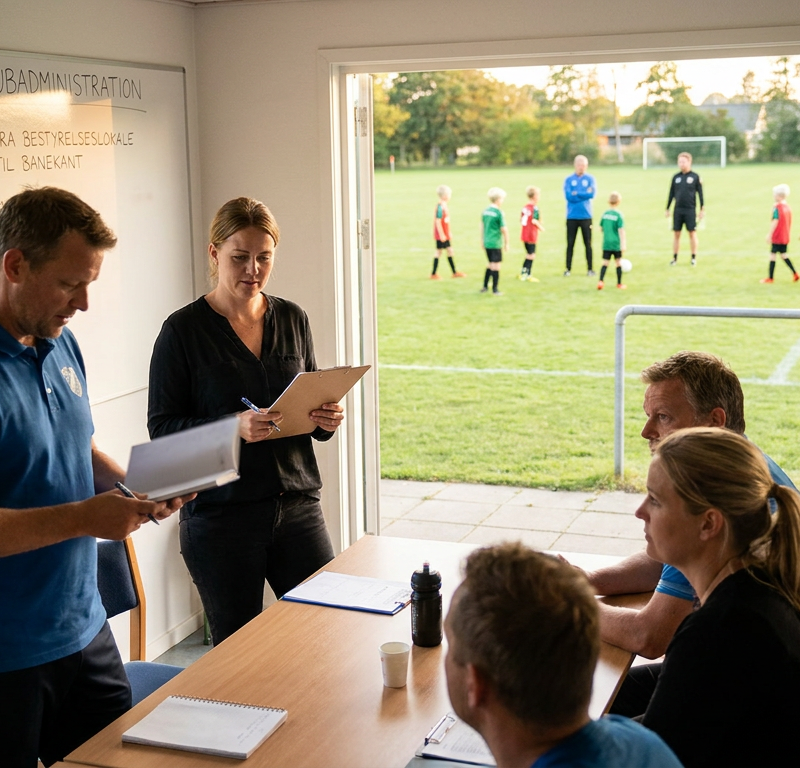
Club administration is the foundation upon which all sporting achievements rest. Without a well-functioning administration, coaches end up spending time on membership fee collection instead of training, and the board spends its meetings on firefighting rather than strategy. But how do you build an administrative model that actually holds water in a busy everyday life?
This article is a practical guide on how you as a club can structure your daily operations to free up resources, create transparency, and make it more fun to be a volunteer leader.
Step 1: Establishing the Administrative Annual Cycle
One of the biggest challenges in club management is the recurring tasks that come as a surprise every year. General meetings, applications for local facility grants, player registration, and end-of-season events are fixed elements that should not cause stress.
The solution is a visual annual cycle. Here, you plot in all fixed deadlines so everyone on the board and in the administration knows what to expect over the next three months. By knowing the administrative peak periods well in advance, you can distribute tasks better and avoid one person being stuck with everything the week before an important deadline.
What should be included in the annual cycle?
- Budget follow-up: Quarterly checks of the club's finances.
- Sponsor care: When should existing sponsors be contacted for renewal?
- Tax and VAT: Deadlines for settlement if the club is VAT-registered.
- Season start: Booking of pitches, halls, and updating the website's team overviews.
Step 2: Role Distribution and the Digital Secretariat
In many small and medium-sized clubs, roles tend to overlap. The chairman often ends up as a "jack-of-all-trades," which quickly leads to burnout. Effective leadership is about delegating responsibility in a way that makes tasks manageable.
Instead of large, heavy committees, it often works better with smaller "task forces" or function-based areas of responsibility. One person might be responsible for the club's member data, while another solely manages the dialogue with the municipality. By isolating tasks, it also becomes easier to recruit new volunteers because the task is defined and time-limited.
A digital secretariat is a necessity here. By gathering communication, document management, and member systems in one place, you ensure that the club's knowledge doesn't disappear if a key person leaves. Make sure to have a shared cloud solution for minutes, contracts, and guidelines.
Step 3: Optimizing Member Administration and Finances
The heart of the club is its members, but administering them can be a time-sink. A professional approach to club administration requires that membership fee collection takes place automatically. Manual transfers and Excel lists are not only inefficient; they are also vulnerable to errors and GDPR breaches.
Use a system that integrates the member database directly with the club's bank account. This gives the treasurer a real-time view of the club's liquidity and saves the board from eternal discussions about arrears. When finances are streamlined, the board can use its energy discussing investments in facilities or new sporting initiatives.
Remember Financial Transparency
Good leadership involves everyone on the board understanding the club's financial situation. This doesn't require an accounting degree, but it does require simple, monthly overviews. When everyone knows where the money comes from and what it is used for, a culture of accountability is created.
Step 4: Volunteer Management as a Strategic Discipline
Without volunteers, there is no club operation. Yet, volunteer management is often left to chance. A modern administration must have a concrete plan for how to find, onboard, and recognize volunteer power.
Think of the volunteer journey as a funnel:
1. Recruitment: Be specific. Don't ask "Who wants to help?", but "Who can handle driving for the three matches in May?".
2. Onboarding: Give new volunteers a warm welcome and a brief introduction to their task.
3. Recognition: It is rarely about money, but about social cohesion and feeling valued. A volunteer party or a club jacket makes a difference.
By professionalizing this part of the administration, you reduce volunteer turnover, which is the most effective way to ensure stability in club operations.
Step 5: Communication – The Glue in the Club
Internal communication is often the most overlooked part of club administration. If coaches, parents, and members don't know what's going on, frustration and unnecessary questions for the board arise.
Establish fixed channels for communication. Use one platform for important messages rather than spreading information across Facebook, SMS, emails, and notice boards in the hall. When the flow of information is streamlined, the volume of administrative inquiries drops drastically because people know where to find their answers.
Real-life Example: The Football Club with a New Structure
A medium-sized football club experienced their youth department growing by 20% in one year. The administration couldn't keep up, and the treasurer was considering quitting. They chose to implement a "volunteer catalog" where all tasks were split into small pieces (e.g., "responsible for the ball room," "tournament registration for the 2012 age group").
By making the tasks small and manageable, they activated parents who had previously held back. This relieved the central leaders, who could then focus on the club's long-term development instead of pumping balls or chasing membership fees.
Summary: The Path to a Stronger Club
Effective club administration is not about working harder, but about working smarter. By introducing an annual cycle, digitizing heavy processes, and making tasks small and attractive for volunteers, you create a club that is resilient to change.
Start by mapping your current processes. Where do you spend the most time? Which tasks cause the biggest headaches? By attacking the challenges one by one, you will quickly feel the administration shifting from being a heavy burden to being the engine that drives the club's success.