Optimize Your Club Administration: 7 Concrete Tools for an Easier Daily Routine

Club administration in Danish sports associations is often driven by a combination of passion and necessity. However, as requirements for documentation, financial transparency, and member service increase, daily club operations can quickly become an overwhelming burden for the volunteers on the board.
To ensure a sustainable future for the association, it is crucial to shift focus from firefighting to structured management. When administration runs smoothly, time is freed up for what it’s all about: the sport, the community, and the development of the club's members. In this article, we dive into seven concrete areas where your club can optimize operations and create a stronger organization.
1. Create Clear Frameworks for Board Work
Effective administration starts at the top. Many clubs suffer from unclear areas of responsibility, where the same 2-3 people end up handling everything from membership fee collection to purchasing chalk for the pitches. Good leadership is about defining precise roles.
Consider developing functional descriptions for each board member. These don't need to be long, legal documents, but simply a bulleted list of expectations. When the chairman knows exactly what the treasurer is handling, and who is in contact with the municipality, duplication of work and misunderstandings are minimized. This creates peace in club operations and simultaneously makes it easier to recruit new members to the board, as the task appears manageable and well-defined.
2. Digitalization as a Foundation for Club Operations
Today, it is almost impossible to run a modern sports club solely with spreadsheets and loose emails. Digitalizing your administration is not just a luxury, but a necessity to comply with GDPR legislation and ensure continuity.
A central membership system makes it possible to automate fee collections, which is often one of the biggest time-wasters. Imagine a daily routine where the system sends out reminders automatically, and where the treasurer only needs to approve the final figures instead of manually checking bank transfers. Centralizing data also means that knowledge doesn't disappear if a key person chooses to step down from the club.
Real-life example:
A medium-sized football club saw their arrears drop by 40% over a single season simply by switching to an automated payment module. This didn't just put more money in the club coffers, but also removed the uncomfortable calls that volunteers previously had to make to parents who had forgotten to pay.
3. Recruitment and Retention of Volunteers
Volunteers are the engine of any association, but they are also a resource that must be managed with care. A common mistake in club administration is asking for help with "everything and nothing." People want to help, but they want tasks that are time-limited and match their skills.
Try breaking down large administrative tasks into smaller pieces. Instead of looking for a "volunteer coordinator," look for a person who will be responsible for coordinating transport to three specific tournaments, or someone who can update the club's Facebook page twice a week. By making tasks small and concrete, you lower the barrier to saying yes. Remember also that recognition is the currency volunteers are paid in – a structured plan for "thanks" is just as important as a plan for the budget.
4. Financial Transparency and Budget Management
Healthy club operations require tight financial management. The administration must be able to provide updated figures to the board so that decisions can be made on an informed basis. Here, it is essential to distinguish between daily operations (fees, rent, referee fees) and development projects (new clubhouse, artificial turf pitch, hiring a sports director).
Introduce regular budget follow-ups every quarter. If administration is digitalized, it only takes a few minutes to pull a report. This transparency builds trust with both members and potential sponsors, as they can see that their money is being managed professionally.
5. Optimization of Internal Communication
Where does dialogue happen in your club? Is it in a closed Facebook group, on Messenger, via email, or on the notice board in the clubhouse? Fragmented communication is one of the biggest sources of errors in club administration.
Choose one primary channel for official communication between the board, coaches, and committees. This ensures that important messages about pitch times, general meetings, or rule changes are not lost. By professionalizing communication internally, the club also projects a much higher degree of seriousness externally to parents and partners.
6. The Annual Cycle as an Administrative Anchor
Many administrative tasks in a sports club are cyclical. There is the start of the season, license applications, the general meeting, sponsor renewals, and end-of-season parties. Nevertheless, these events often catch the board by surprise every year.
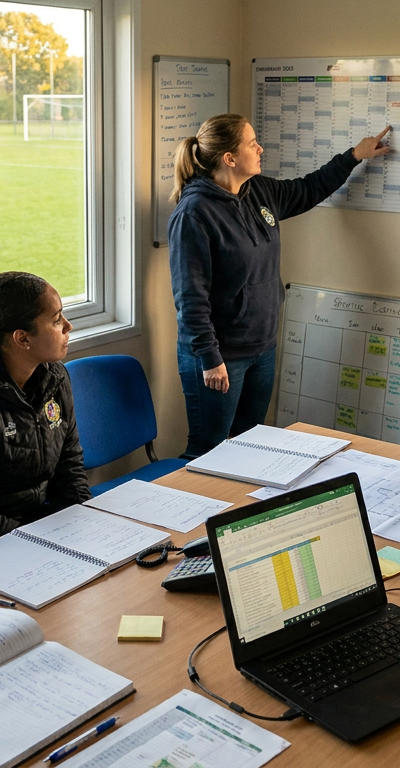
A visual annual cycle (year wheel) is an indispensable tool for managing the club. By plotting all fixed tasks into a calendar, the administration can begin preparations in good time. If you know that sponsorship agreements need to be renewed in June, work should start in March. An annual cycle removes stress and allows volunteers to plan their efforts in relation to their own work life and family.
Tips for the annual cycle:
- August: Updating membership lists and checking coach contracts.
- October: First budget draft for next year and dialogue with existing sponsors.
- January: Preparation for the general meeting and annual accounts.
- April: Planning summer activities and tournaments.
7. Relations and Networks within the Club
Administration and management must never become an isolated island in the clubhouse. Strong club operation is built on relationships. Ensure that the administrative forces are visible out on the pitches or in the hall. When members get to know the people behind the systems, understanding of administrative decisions increases.
Networking is also about looking beyond your own club. Participate in municipal sports councils or sport-specific federation meetings. Often, the neighboring club is dealing with exactly the same administrative challenges, and there can be great benefits in sharing experiences on everything from pitch bookings to IT systems. Cooperation across associations can even lead to shared administrative solutions that save resources for all parties.
Conclusion: Small steps, big impact
It is important to remember that good club administration is not created overnight. It is an ongoing process where small improvements accumulate over time. Start by identifying your biggest "pain point" – is it finances, the lack of volunteers, or an outdated membership system? – and take action there first.
When you invest time in optimizing club operations and leadership, you invest in the club's survival and growth. A well-run club attracts more members, more volunteers, and more sponsors, because it is clear to everyone that things are under control here, and it is a pleasant place to be.