Industry-Focused Networking vs. Broad Events: Which Model Drives the Most Growth?
When a sports club designs its commercial strategy for its business network, management often faces a fundamental choice: Should we create a broad framework where everyone can participate, or should we facilitate deep, industry-specific spaces for networking? Both approaches have their merits, but they serve very different purposes and require different resources.
In this article, we compare the two most common models for organizing networks and events in the world of sports. We look at how they affect engagement, sponsor retention, and the concrete bottom line of the participating companies.
The Inclusive Model: Large Broad Events
Broad events are the classic arrangements that most people associate with sports clubs' business networks. This could be the big pre-season kick-off, sponsor trips, or traditional VIP events on match days. Here, the focus is on volume, social interaction, and a shared passion for the sport.
Advantages of Broad Events
The greatest strength of large events is their ability to create a sense of community and "tribe mentality." When 100 different business owners stand in the same room, a synergy effect arises that strengthens the club's brand. This is often where the first seeds of new relationships are sown because barriers are low and the atmosphere is informal.
For smaller businesses, these events can be a fantastic entry point into the business community, as they gain access to decision-makers they would normally never meet. Engagement here is driven by the experience – being "close to the team" or hearing the coach's strategy before kick-off.
Disadvantages and Pitfalls
The challenge with large, broad events is often "the noise-to-signal ratio." Because everyone is invited, it can be difficult for individual sponsors to find the exact partners relevant to their business. Networking becomes accidental rather than strategic. If a club focuses exclusively on large events, there is a risk that the most serious B2B companies will drop out because they don't feel their time is being converted into direct business value.
The Focused Model: Industry and Interest Circles
Conversely, there is the more niche-oriented approach where the club divides its network into smaller groups based on industries (e.g., construction, IT services, or consultancy) or specific professional challenges (e.g., export or digital transformation).
Advantages of Industry-Focused Networking
When you gather people with the same professional challenges, the quality of conversation increases exponentially. In a smaller forum, participants are more likely to share concrete leads, brainstorm complex issues, and enter into binding collaborations. For the club, this means a higher degree of retention, as members become dependent on the insights they gain within their specific group.
This model also makes it easier to measure the success of an event. If a meeting for construction partners results in three concrete subcontracts, the value of the sports club sponsorship is easy to prove to the sponsor's accounting department.
Disadvantages and Resource Requirements
The main disadvantage of this model is the need for high-quality facilitation. Small groups die out quickly if there isn't a strong moderator who dares to place demands on participants and manage the agenda strictly. Furthermore, it requires more administrative resources to manage many small events rather than one large one.
Comparison: Which Needs Do They Meet?
To choose the right strategy, the club must look at its sponsor base. Here is a comparison of the two types of events based on key parameters:
1. Time and Engagement
Broad events often require less preparation from participants. You show up, eat, watch a match, and talk to people you know. Industry networks require higher engagement; participants are often expected to contribute knowledge or actively look for opportunities for others in the group.
2. Business Conversion
If the goal is direct leads and sales (transactional networking), focused meetings win every time. If the goal, however, is branding, awareness, and building trust over time (relational networking), large events can be more effective at opening doors.
3. Atmosphere and Culture
Large events thrive on energy and excitement. They remind sponsors why they love the club. Focused meetings thrive on substance and confidentiality. They remind sponsors why the club is a good investment for their company.
The Hybrid Model: The Optimal Solution?
The most successful sports clubs today rarely choose either-or. Instead, they use a hybrid model where large events function as the "top of the funnel." This is where new members are welcomed and the club's successes are celebrated.
From these large events, members are then channeled into smaller, more committed networking groups where actual B2B business takes place. By combining the two, the club ensures both emotional connection (through the great synergy of sports) and rational connection (through tangible business added value).
Concrete Real-World Examples
Imagine a medium-sized Danish handball club. Four times a year, they host a large "Business Lunch" for all 150 sponsors with external guest speakers. This creates visibility and cross-industry networking. As a supplementary layer, they have established a "Tradesman Club" that meets every other week at 07:00 AM. Here, the agenda is fixed: Which tenders have we seen? Who needs an electrician for a current project? Whom can we recommend?
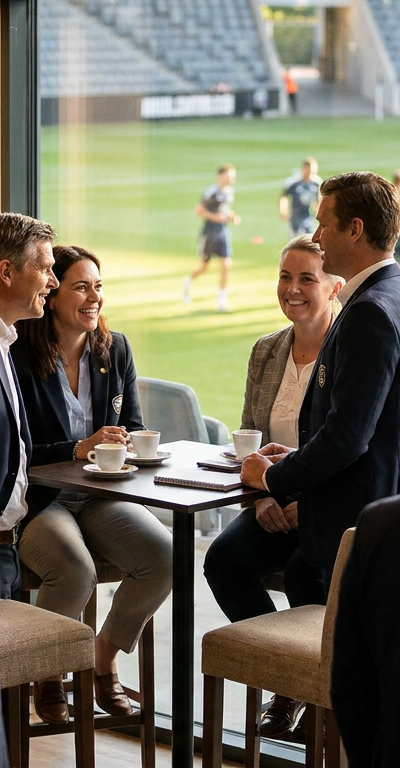
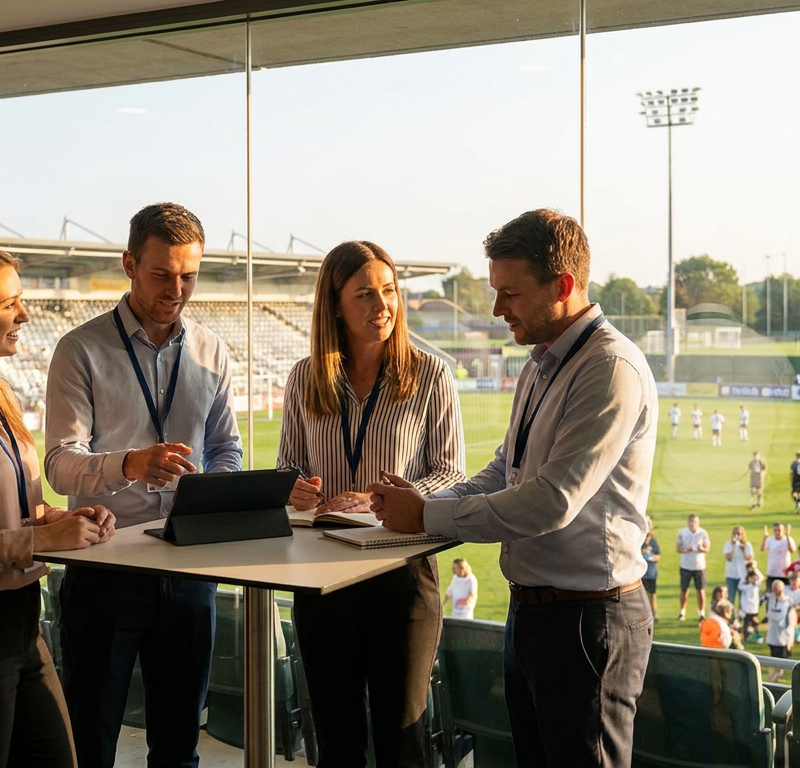
Another example could be a Superliga club using their Skyboxes for industry-specific "Round Tables" on non-match days. Here, they might invite all their IT partners to a session on cybersecurity, facilitated by an expert. In this scenario, the club becomes not just a recipient of money, but a facilitator of necessary knowledge.
How Does Your Club Choose?
When deciding which path your club should take in your event planning, you should ask the following questions:
- Do we have the internal resources to facilitate small, demanding groups?
- Do our sponsors want quick business results, or are they primarily seeking experiences?
- Is our current network large enough to be segmented into industries?
- How do we measure the success of our current events?
Networking is not a static discipline. By constantly evaluating the balance between the broad and the focused, a sports club can position itself as an indispensable partner for the local and regional business community. Regardless of which path is chosen, the most important thing is to be conscious of the purpose of each individual setup.
Ultimately, successful events are about understanding that sponsors aren't just buying a logo on a jersey or a sausage during half-time; they are buying access to relationships, knowledge, and growth opportunities. By mastering both broad and focused formats, the club ensures the best conditions for delivering exactly that.