How to ensure continuity in key club personnel through strong administration

In many Danish sports clubs, the foundation rests on the shoulders of a few, dedicated key personnel. It is the treasurer who has served for 15 years, the chairperson with the large network, or the volunteer coordinator who knows all the parents. But what happens on the day they choose to stop? Without a set structure, the club risks losing invaluable knowledge, important contacts, and momentum in its development.
Ensuring continuity in key club personnel is not about making people indispensable, but precisely the opposite: building an administration that is so robust that the club can continue to run, regardless of who holds the individual positions. In this article, we dive into how your club can create a framework for operations and management that ensures a smooth handover and long-term success.
Why vulnerability arises in club leadership
Vulnerability in sports clubs often arises as a byproduct of great passion. Because tasks are solved by volunteers in their spare time, many processes become "informal." Things are agreed upon over a cup of coffee, or the treasurer saves receipts in their own system without anyone else having insight. When this person stops, an administrative black hole occurs.
To counteract this, management must shift the mindset from "person-driven operations" to "system-driven operations." This does not mean that personal relationships should disappear, but that the data and procedures supporting the club's survival must be democratized and accessible to the board and relevant volunteers.
The danger of the "hidden" network
One of the biggest challenges for continuity in key club personnel is the relationships that exist with sponsors and the municipality. Often, it is the chairperson's personal friends who sponsor the club. If the contact with these stakeholders lies exclusively in one person's phone book, the club is extremely vulnerable during a change of chairperson. A centralized registry of all agreements and contact persons is therefore essential.
Establishing a digital knowledge bank
The first step toward ensuring continuity is to create one place where all knowledge is gathered. This is the heart of a modern club administration. A digital knowledge bank should, at a minimum, contain the following elements:
- Statutes and rules of procedure: Documents that define the club's overall rules.
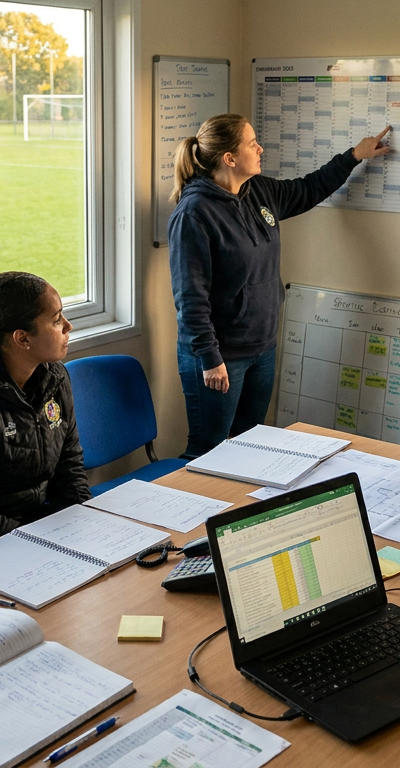
- Annual cycle: A detailed calendar of all fixed administrative tasks (general meeting, application deadlines for funds, deadlines for field booking, etc.).
- Login overview: A secure overview of passwords for business IDs, the bank, social media, and the club's website.
- Sponsor overview: Who are the sponsors, what have they promised, and when do the contracts expire?
By having this structure in place, the fear of taking over a position is reduced. Many volunteers decline board work because they fear the amount of unknown work. When they can see that things are under control, it becomes easier to recruit new faces.
Role descriptions: Making tasks transparent
A significant barrier to continuity in key club personnel is unclear expectations. Often, a person does not even know how much they actually do until they have to explain it to a successor. Here, written role descriptions are an invaluable tool.
A good role description in a sports club should contain:
- An estimate of time consumption per week or month.
- Specific areas of responsibility (e.g., "responsible for collecting membership fees").
- Which IT systems the person must master.
- Who they report to and who they collaborate with.
Once tasks are defined, it also becomes possible to split large roles into smaller parts. If the treasurer position seems too overwhelming, you might have one person for bookkeeping and another for budgeting. This creates a broader pipeline of volunteers, which strengthens the club's resilience.
Succession planning: Plan the replacement in time
In the business world, we talk about "succession planning" – that is, planning who will take over positions in the future. In the sports club, we call it due diligence. A board should never be surprised that a member wishes to stop at the next general meeting.
"Shadowing" as a learning tool
An effective way to ensure continuity in key club personnel is by letting the new person "shadow" the current one for a period of 3-6 months. If a new treasurer starts immediately after a general meeting without overlap, they must learn everything from scratch in the middle of the club's busiest period. By letting them participate as a "deputy" or "apprentice" in the months leading up to it, they can get to know the systems while the experienced person is still available for questions.
Mentoring schemes for young leaders
Consider letting experienced former leaders act as mentors for the new ones. Even if the former chairperson has stepped down from the board, they can still function as an advisor who ensures that institutional memory is not lost. However, this requires a culture in the club where it is okay to let go and let the new people find their own way.
Systematization of volunteer care
Continuity is not just about the top positions in management, but also about the volunteers who carry the administration in everyday life – the people who keep track of laundry, keys, or tournament registrations. If these people burn out, the club loses stability.
A structured administration ensures regular check-ins with all key personnel. Ask about their well-being: Have the tasks become too many? Are they missing tools? By addressing problems early, you can often prevent a person from suddenly quitting in frustration, which creates the least favorable starting point for a good handover.
Using small digital victories
Automation of time-consuming tasks is a direct way to ensure continuity. If administration feels like a chore characterized by manual data entry, key personnel will move on faster. By using modern tools for invoicing, membership management, and communication, you free up time for what is actually fun: creating a framework for sports and community.
Checklist: Is your club ready for a change?
To test your ability to maintain continuity in key club personnel, you can go through this short checklist at the next board meeting:
- If our treasurer were hit by illness tomorrow, who has access to the bank and the accounts?
- Do we have a list of all our sponsorship agreements and when they are due for renegotiation?
- Is there a guide on how to book fields or halls with the municipality?
- Do we know which members in the club have skills we can put to use in administration?
- Have we updated our annual cycle within the last 6 months?
If the answer is "no" to more than two of the above points, it is time to tighten up administrative processes. It is not about control, but about looking after the club's future.
Conclusion: The robust club is the documented club
Continuity in key club personnel is not achieved through luck, but through conscious work with club operations. By documenting processes, centralizing data, and planning replacements well in advance, you create an association that is resilient to the natural turnovers that will always occur in a voluntary organization.
When the administration runs stably, it doesn't just become easier to run the club – it also becomes far more attractive for new committed people to step in and take over. A well-run club does not die with its leadership; it grows and develops from generation to generation.
Read more: CRM til sportsklubber