Future Club Management: 5 Strategic Steps to Professional Club Operations
Running a modern sports club today requires far more than just knowledge of the game on the field. It requires a structured approach to management, a sharp financial sense, and the ability to navigate a complex landscape of legislation, member care, and volunteerism. For many boards, daily administration can feel like an endless stream of firefighting, but with the right strategic steps, you can transform club operations into a self-running machine.
In this article, we dive into how your board can lift its gaze from dry numbers and practical chores to instead create a sustainable organization that attracts both members and volunteer resources.
1. The Board as a Strategic Body Rather Than an Operations Team
One of the biggest pitfalls in club life is when the board becomes too involved in daily operations. If the chairman is personally responsible for buying sausages for the cafeteria and the treasurer manually books every single cup of coffee, there is no time to think about the club's future. Professional club management starts with a clear separation between strategy and execution.
The board's primary task should be to set the direction. This means defining goals for the next 2-3 years. Do we want to be the largest club in the region, or do we want to be the association with the strongest social cohesion? Once the direction is set, the administration must be organized to support these goals, not limit them.
Task Distribution and Committee Structures
To free up time on the board, it is essential to work with committees. By delegating specific areas of responsibility – such as a sponsorship committee, a youth committee, or an event committee – you place decision-making power closer to the volunteers who have their hands in the material. This requires trust, but it is the prerequisite for growth.
2. Optimization of Administration Through Process Optimization
Administration does not have to be a heavy burden. Many clubs suffer from "the way we’ve always done it" syndrome, where workflows have been inherited through generations without regard for modern solutions. Start by mapping your most time-consuming processes. Typically, these will be membership billing, handling coach contracts, and communication with parents.
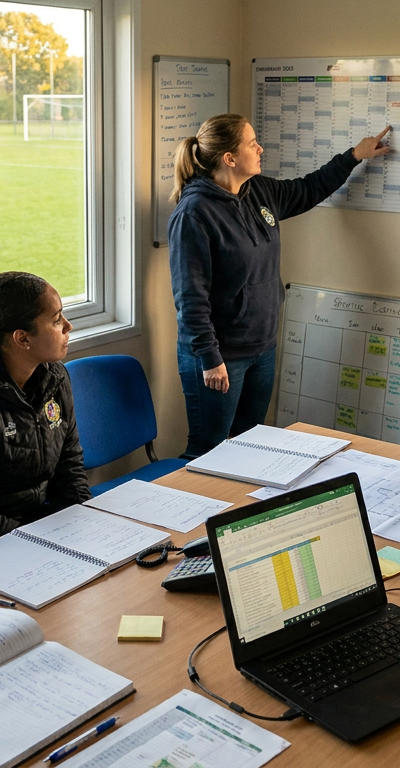
By implementing fixed procedures for the annual cycle (the "year wheel"), you can avoid stressful periods leading up to the start of the season. A digital year wheel, accessible to the entire management team, ensures that no tasks fall between two stools and that knowledge does not disappear if a board member leaves the club.
3. Volunteer Management: From Duty to Desire
Without volunteers, the club ceases to exist. However, we see a trend where it is becoming harder to recruit people for the long haul. The solution is often found in the way tasks are presented. No one wants to say yes to an "unlimited" amount of work without an end date.
Effective management of volunteers in a modern club is about making tasks small and manageable. Instead of looking for a "volunteer coordinator," look for a person who will handle the coordination of transport for the next four away games. By time-limiting the tasks, you lower the bar for participation.
Recognition and Retention
Remember that administration is also about nurturing human resources. A structured plan for volunteer care – whether it's an annual dinner, clothing packages, or simply a personal thank you from the chairman – is crucial for the club's long-term operation. It costs much more time to find a new volunteer than it does to retain an existing one.
4. Financial Management and Transparency
Finances are the foundation for everything fun in the club. Healthy club operation requires that the board has a real-time picture of the finances and does not merely look at an account once a year at the general meeting. It's about moving from being backward-looking and passive to being proactive.
Divide your budget into operating costs and investment pools. If the administration runs efficiently and the collection of membership fees is automated, arrears are significantly minimized. This frees up capital that can be reinvested in better facilities or teacher training, which in turn increases value for members.
Diversification of Income
Relying solely on membership fees is risky. A professional administration works actively to spread income sources. This can be through:
- Sponsorships with clear reciprocal services (e.g., exposure on social media or signage).
- Municipal subsidy schemes and foundations (requires documentation and patience).
- Events and tournaments that not only create life but also a profit for the club coffers.
5. Communication as an Administrative Tool
Poor communication leads to more administrative questions. If parents and players do not know where to find information about training times, registration, or laundry, they will contact the board or the coaches directly. This creates unnecessary noise.
A professional club ensures that communication is centralized and easily accessible. By using one primary channel for official announcements, you reduce the risk of misunderstandings. This saves countless hours in administration when members can find answers to their questions themselves via an updated platform or app.
The Good Example: From Chaos to Structure
Imagine a medium-sized swimming club where coaches manually checked attendance on paper lists, and the treasurer sent reminders by letter. By reorganizing their entire administrative setup into a digital structure where registration and payment happened synchronously, and communication to parents ran automatically via notifications, they reduced the board's time consumption by 40%. That time was instead used to apply for grants for a new training camp, which resulted in a record intake of new talent.
Conclusion: The Virtuous Circle
Just as the athletes on the field must train to get better, the club's leadership and administration must also develop. By shifting focus from firefighting to strategic leadership, and by giving volunteers frameworks in which they can succeed, you create a virtuous circle. A well-run club creates better results, a stronger community, and a more sustainable future.
Take on one area at a time. Perhaps start by looking at your internal task distribution or your annual cycle. Small improvements in administrative routines can quickly be felt on both the bottom line and the mood in the boardroom.