Facilitating the Perfect Network Flow: How to Design Events That Generate Leads
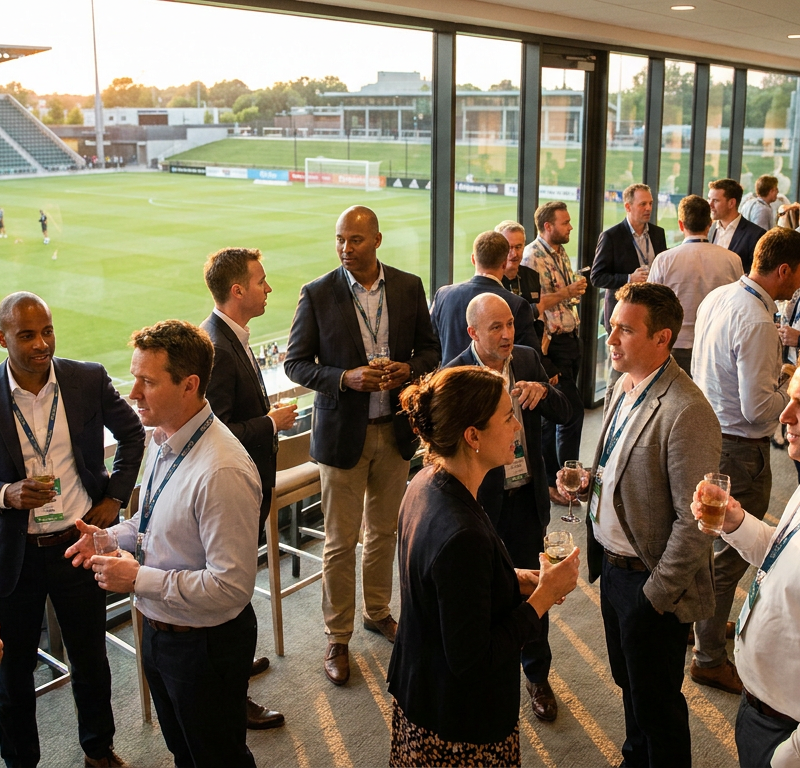
In many sports clubs, networking events have become a staple of the sponsorship value proposition. However, there is a big difference between an event where participants simply drink coffee in separate corners and a professionally facilitated arrangement that leads to actual orders and strategic partnerships. To ensure your sponsors keep renewing their contracts, you must be able to document that your network moves their business forward.
In this article, we dive into how you design the actual flow of your events to remove the barriers that often arise in networking and instead create a natural framework for commercial success.
Designing the Right "Venue Flow"
The physical space plays a crucial role in how participants interact. If you place all chairs in rows facing a stage, you signal passivity. If, on the other hand, you work with zones, you can control the intensity of the participants' networking.
Consider dividing your event area into three zones:
- The High-Speed Zone: Standing tables placed centrally where people can quickly greet many others and exchange business cards.
- The Deep-Dive Zone: Smaller lounge areas with lower noise levels where two partners can go into depth with a specific dialogue they have just started.
- The Activity Zone: An area where a small competition or product demonstration takes place, acting as a natural "ice-breaker."
By consciously guiding your sponsors through these zones during an event, you ensure they don't get stuck in the same groups of people they already know.
Exposure through Micro-Segmentation
One of the biggest challenges at larger events is that sponsors lose their overview. To increase engagement and relevance, you should work with micro-segmentation before and during the event itself.
Instead of just sending out a participant list, you can divide your network members into relevant groups, such as "Construction & Engineering," "Consulting & IT," or "Retail & Service." During the event, you can set aside 15 minutes where people are encouraged to visit "industry-related zones." This makes it far less intimidating for a new sponsor to step into a conversation because they know in advance that they share professional challenges with the people in that specific zone.
Using "Connectors" in the Network
As a club employee or volunteer, your most important task is not to serve coffee, but to act as a "connector." A good connector knows their sponsors' needs inside out. If you know that a master carpenter is looking for a new accountant, and the accountant is sitting alone at a buffet, it is your job to bring them together with a brief, value-based introduction.
Example: "Jesper, you mentioned last time that you were looking into succession planning. Have you met Mette from Revision Syd? She is an expert in exactly that process." This type of active facilitation makes your network indispensable.
Create Engagement through "Problem-Solving" Sessions
Traditional presentations can often kill the energy in a room. An effective way to create more dynamic events is by switching from one-way communication to collaborative workshops. Try letting a sponsor present a real business challenge to the rest of the network.
When 20-30 local business leaders contribute their experiences to solve one partner's challenge, a deep sense of community and mutual respect is created. It shifts the focus from "what can I sell?" to "what can we solve together?", which is the very core of a strong network.
Time Management and the Golden Ratio
Respect for your sponsors' time is crucial. A networking event should never feel like a waste of time. A good rule of thumb is the "60/40 model":
- 60% of the time should be spent on structured and unstructured networking.
- 40% of the time can be used for presentations, dining, or club updates.
If your speeches and presentations take over, you remove the opportunity for sponsors to create the relationships that finance their membership.
Digital Tools for Physical Events
Even though we are talking about physical events, technology can act as a catalyst for engagement. Using simple polling tools or a dedicated app where sponsors can see each other's profiles and book short "speed-dates" during the event can significantly increase efficiency.
When a participant can see who is present and what their competencies are before they even arrive at the stadium, the likelihood increases that they will come well-prepared and close deals or agreements during the event.
Follow-up as an Integrated Part of Event Design
An event doesn't end when the last guest has left. The real value arises in the week after. As a club, you have a unique opportunity to send a short message to participants with the question: "Did you talk to the right people, or is there anyone I should introduce you to?"
By making the follow-up proactive, you show that the club takes the sponsors' business success seriously. This builds the loyalty that keeps sponsors in the network year after year, regardless of whether the sporting results on the pitch fluctuate.
Conclusion: From Event Organizer to Business Developer
Running a successful business network in a sports club requires you to see yourself as more than just an event coordinator. You are a business developer for your partners. By focusing on flow, segmentation, active facilitation, and rigorous follow-up, you transform your events from social gatherings into strategic growth engines.
Remember that the best networks are those where participants feel they get more value out than they put in. When you dare to manage the flow and actively match people together, you create an environment that the business community cannot afford to be outside of.