Best Practice in Club Administration: From Good Intentions to Strong Operations
Running a modern sports club today requires far more than just knowledge of the game on the field. It requires a structured approach to administration, a clear management strategy, and the ability to navigate a complex landscape of legal requirements, financial management, and human relations. Professional club operation is not necessarily about having full-time employees, but about having processes that make work easier for both the board and volunteers.
In this article, we review the best practices that characterize the most well-functioning sports associations in Denmark. We dive into how you create a common thread from the boardroom to the training field, and how you ensure that your focus remains on growth and athletic development rather than administrative bureaucracy.
The Board's Role: Strategic Management Rather Than Firefighting
One of the biggest challenges in Danish club administration is when the board gets caught up in daily operational tasks. When board meetings are exclusively about missing keys to the ball room or a broken coffee machine, you lose sight of the club's future. Best practice in management dictates that the board should function as the club's strategic heart.
To achieve this, the board must define clear areas of responsibility. A good model is to divide management into three classic pillars: sports, finance, and operations/administration. By having permanent committees under the board, detailed tasks can be delegated so that those with the ultimate responsibility can focus on the club's bylaws, partnerships, and overall well-being. This creates a professional distance that makes it possible to make difficult decisions without being hampered by everyday small conflicts.
The Annual Cycle as the Club's Administrative Anchor
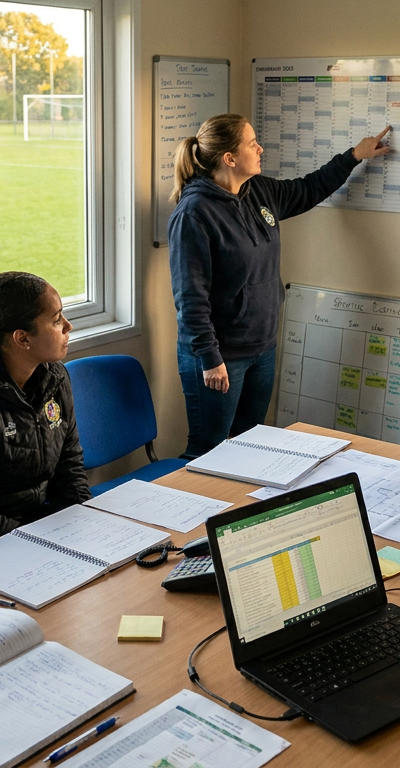
No tool is more important for healthy club operations than a well-developed annual cycle. Many clubs experience stress when they discover that deadlines for member subsidies, general meetings, or sponsorship agreements are suddenly looming. An annual cycle is a visual and operational document that establishes all recurring tasks throughout the year.
An effective annual cycle should include:
- Fixed deadlines for member reporting and applications for municipal local subsidies.
- Planning of season start and end celebrations.
- Dates for follow-up on existing sponsorships and campaigns for new ones.
- Checking criminal records/child protection certificates (a critical task in Danish club administration).
- Budget follow-up and year-end accounting.
Volunteer Culture: Structure Creates Engagement
Volunteers are the engine of any sports club, but their time is precious. Best practice in modern club administration is about making it "easy to be a volunteer." This means moving away from the classic "we need hands" approach and instead presenting defined tasks with a clear end point.
When a club has its administration under control, it knows exactly which roles need to be filled. Instead of seeking a "helper for the kiosk," you should seek a person for the "Saturday shift from 10-14 responsible for brewing coffee and till sales." The more specific the task is, the easier it is for people to say yes. This reduces the risk of the few regular volunteers burning out because they have to take on too much.
Onboarding of New Volunteers
When a new coach or volunteer enters the club, a "welcome package" should be ready. This is part of administrative best practice that ensures continuity. The package should contain passwords for relevant systems, an overview of contact persons, an introduction to the club's values, and a guide on how to handle reimbursements or booking of pitches. A structured reception sends a signal of professionalism and security.
The Digital Core of Club Administration
One cannot talk about modern management in a club without addressing the technological foundation. Today, it is no longer sustainable to manage a member base in an Excel sheet that is sent back and forth between board members. Central databases are the foundation for everything from membership fee collection to internal communication.
Digitization is largely about minimizing manual workflows. For example, membership fees should be collected automatically via payment cards, so the treasurer doesn't have to spend hours chasing missing payments. Similarly, the website should be integrated with the member system so you always have updated lists of teams and coaches without having to edit in two places. This frees up time that can instead be used to develop athletic offerings or nurture relationships with the local business community.
Data Security and GDPR
As part of administrative operations, the club is obliged to protect member data. Best practice here is to have a written privacy policy that is easily accessible. Furthermore, the club must ensure that sensitive information – such as lists of arrears or child protection certificates – is only available to the few people who actually need it. A modern administrative platform often helps the club automatically comply with these rules.
Financial Management and Transparency
A healthy club economy is the prerequisite for sporting success. The administration must ensure that there is complete transparency in the accounts. This creates trust among both members and potential sponsors. Best practice here is to operate with real-time bookkeeping so the board can see the club's liquidity at any given time.
The success of club operations is often measured by the ability to diversify income. A one-sided dependence on membership fees makes the club vulnerable to fluctuations in membership numbers. Therefore, the administration should have processes for ongoing pursuit of grants and external financing. By having fixed templates for applications and documentation of the club's social impact, you can streamline the work of obtaining funds for new facilities or youth projects.
Communication as a Management Tool
Good club management extends beyond internal ranks. How the club communicates with the outside world – parents, members, the municipality, and the local community – is crucial for its reputation. A well-run club has a clear communication strategy that tells the good story of the club's community.
Administratively, this means having fixed channels. Should important messages be sent via email, social media, or a closed club app? To avoid confusion, the club should decide on one primary channel for each target group. This ensures that no one misses information about pitch closures, general meetings, or coach changes.
Involvement and Democratic Processes
In the crossfield between professional operation and the classic Danish association model lies member involvement. A best practice is to hold member meetings or workshops outside of the general meeting itself. Here, you can get input for the club's development without the formal agenda. This strengthens the sense of ownership among members, which in turn makes it easier to recruit volunteers for future tasks.
Conclusion: The Cohesive Club
Achieving best practice in club administration does not require miracles, but rather patience and systematic effort. By shifting focus from ad hoc solutions to fixed processes, you create the foundation for a club that does not just survive, but thrives. It is about using digital tools correctly, guarding volunteer resources, and letting the board lead the club strategically into the future.
When administration runs smoothly, it is felt all the way down to the individual athlete. This is where the surplus energy is created to generate the good experiences and the strong community that is the true purpose of sports. Start small – create an annual cycle, define your committees, and see how calmness spreads through your club operations.