Best-practice for modern workforce management: From recruitment flow to effective shift execution
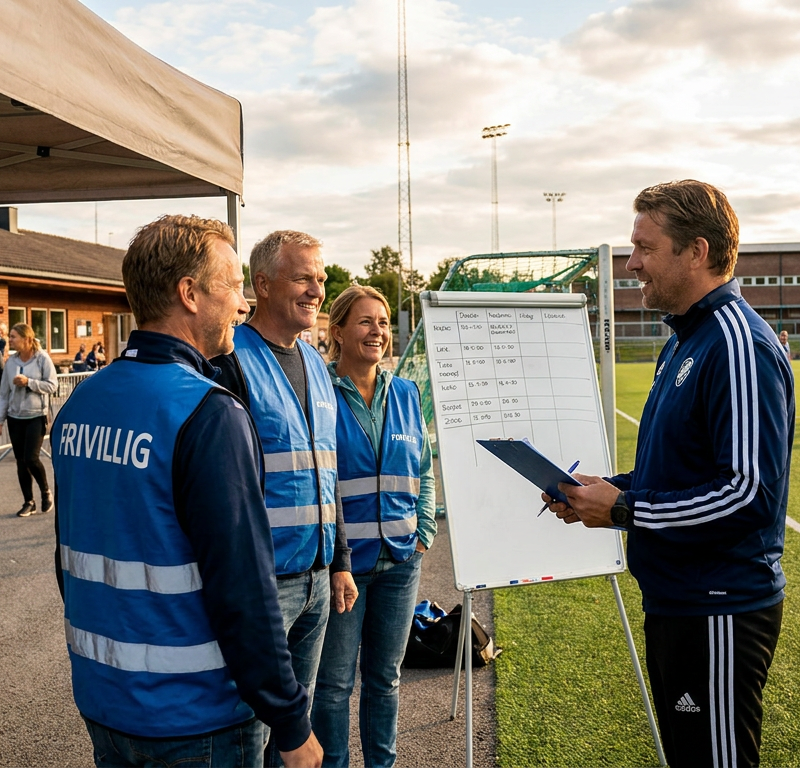
Volunteers are the foundation of every Danish sports club. Without the right personnel, local derbies, youth tournaments, and daily cafeteria operations would not be able to function. But in a time where leisure time is scarce, it requires more than just a general call to "help out" if you want to ensure stable operations.
To create a healthy club culture and efficient staff planning, the work with volunteers must be viewed as a professional discipline. It is about moving from gut feelings to data and structured processes that make it easy to be a volunteer and manageable to be a coordinator.
Structure your recruitment: Find the right skills
Recruitment of volunteers often becomes an ad-hoc task that is only prioritized when the shortage is acute. One of the most important best practices is to flip this process on its head. Start by mapping the club's needs precisely. What does a shift in the sausage stand require versus a shift as a match scheduler or treasurer?
Create precise task descriptions
Many potential volunteers hold back because they fear the task is unmanageable or too time-consuming. By creating short, concrete job descriptions (e.g., "Help in the kiosk for 3 hours during the U12 tournament – we'll teach you to use the cash register in 5 minutes"), you remove uncertainty. The more specifically you communicate, the easier it is for the personnel to say yes.
Segmented recruitment
Don't always approach the entire club at once. Segment your search. Need help with accounting? Ask the parent group specifically for someone with a financial background. Is there painting or repair work needed at the facility? Look for tradespeople in the member database. When people feel that their specific skills are in demand, the motivation to contribute increases.
Staff planning: Make shifts easily accessible
Once volunteers are found, the operational work of staff planning begins. A classic pitfall in sports clubs is the use of confusing Excel sheets or posts in closed Facebook groups where information quickly disappears in the crowd.
Self-service increases engagement
People want flexibility. A modern best practice is to implement a system where volunteers can go in and choose the shifts that fit their calendar themselves. When staff have autonomy over their own time, they feel a greater sense of ownership over the task. This simultaneously reduces the administrative pressure on volunteer managers, who don't have to spend hours calling around to "piece together" the rota.
Visibility and transparency
It should always be clear how many hands are missing for a given event. By visualizing the workforce coverage (e.g., with a counter: "We are missing 4 out of 10 helpers for Sunday's match"), you create a natural sense of responsibility in the club environment. People are more likely to help when they can see that their contribution makes a concrete difference for the community.
Operational shift management: Calm on match day
The actual execution of match days or events is where your planning stands its test. Effective workforce management here is about ensuring everyone knows exactly what to do from the moment they show up.
Check-in and onboarding on-site
Make it a fixed routine to have a "shift manager" to welcome the volunteers. A short 2-minute briefing and a set of instructions (perhaps just a laminated sheet at the workstation) ensure that the volunteer feels confident. Lack of clarity regarding tasks is the biggest source of frustration among volunteers.
Handling cancellations and reserves
No matter how good the planning is, acute cancellations will occur. A best practice is to have a "contingency list" – a group of volunteers who have agreed to be contacted at short notice, or who may already be present as spectators. Communication here should take place via SMS or push notifications to ensure rapid response.
Retention: Create a positive experience for the team
It is far cheaper and easier to retain an existing volunteer than to recruit a new one. Therefore, "aftercare" is a central part of workforce management.
Recognition at eye level
It sounds cliché, but a "thank you for your help" after the shift is finished is the most important tool for retention. Small gestures like a free cup of coffee, a club shirt for the crew, or an annual volunteer party make a world of difference. It’s about creating an identity as part of "the team behind the team."
The feedback loop
Ask your volunteers after an event: "What worked, and what could we do better?". When the personnel are heard, they feel like an important part of the club’s development. If a shift has been chaotic due to missing equipment or poor planning, it is essential to correct it for next time so volunteers don't lose heart.
Digitalization as a catalyst for growth
Even though you can get far with good intentions, there is no way around the fact that manual administration of personnel is a time thief. Digitalizing your processes is not just a luxury – it is a necessity for scaling the club.
Advantages of a centralized system
By consolidating recruitment, shift scheduling, and communication in one system, you ensure:
- That data is stored in one place (important for GDPR).
- That history is preserved when there are changes in the board.
- That communication to volunteers becomes professional and timely.
When administration runs automatically, volunteer managers can spend their energy on what really matters: nurturing relationships with the people in the club rather than struggling with inadequate spreadsheets.
Real-life example: Tournament planning in a football club
Imagine a medium-sized club organizing a large summer tournament with 100 teams. Here, 80 volunteers are needed over a weekend for everything from parking duty to referee tables.
Without structure: The board sends out desperate emails 14 days before. They get 30 sign-ups. On the day, people are missing, the remaining volunteers have to work twice as hard, become stressed, and do not want to help next year.
With best practice: Tasks are defined and posted 3 months in advance. Parents log in and take a shift that fits with their children's matches. The week before, everyone receives an automatic reminder with info on the meeting point. During the tournament, a coordinator provides food and drinks for the helpers. After the tournament, a thank-you email is sent with a photo of the happy children. The result is a successful execution and a workforce that is already looking forward to next time.
Conclusion
Effective management of volunteers and personnel is about balance. On one hand, hard structural frameworks with clear rotas and digital tools are required. On the other hand, soft values like recognition, community, and meaning are essential.
By implementing the best practices described here, your club can transform volunteer work from being a constant source of concern into being one of the club's greatest strengths. Start small: define one task precisely, choose one digital tool for shift planning, and remember to say thank you every single time.